The bells of St. Peter’s Basilica tolled solemnly on Saturday(April 26) morning as tens of thousands of mourners gathered under the gray skies of Vatican City to bid farewell to Pope Francis, the “Pope of the People.” In a moment that captured both spiritual reverence and geopolitical weight, royalty, world leaders, and pilgrims from every corner of the globe came together to pay final tribute to the late pontiff.
Despite the presence of presidents, prime ministers, and princes, it was prisoners and migrants who were first to carry his coffin into St. Peter’s Basilica, reflecting the priorities that defined Francis’ 12-year papacy.
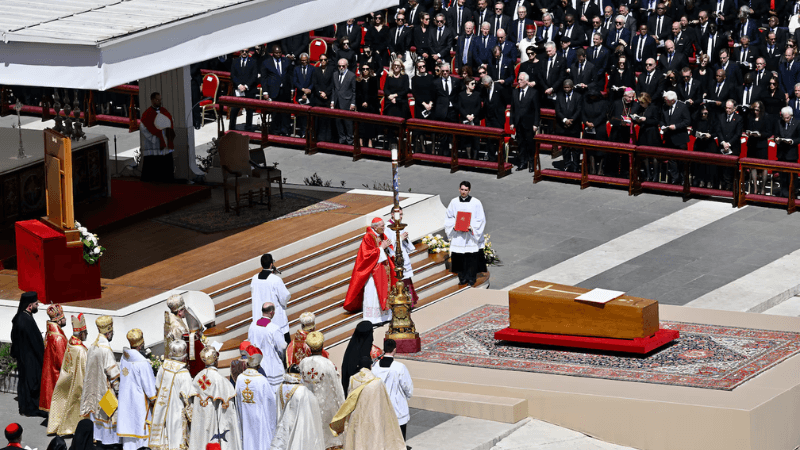
The simple coffin, adorned only with a crucifix and Francis’ coat of arms, was carried down the basilica’s central aisle before being brought into St. Peter’s Square. A sea of red-robed cardinals followed, as spontaneous applause erupted across the square—a final tribute to a man who championed humility over hierarchy.

The funeral became one of the largest gatherings of global leaders in recent memory, reminiscent of the farewell to Pope John Paul II two decades ago. Among those seated prominently were U.S. President Donald Trump and First Lady Melania Trump, French President Emmanuel Macron and First Lady Brigitte Macron, Finnish President Alexander Stubb, Spain’s King Felipe VI, and Estonia’s President Alar Karis.
European Commission President Ursula von der Leyen, Hungarian Prime Minister Viktor Orban, Italian Premier Giorgia Meloni, and Argentine President Javier Milei joined a host of dignitaries, while Britain's Prince William, attending on behalf of King Charles III, carried out his most significant international duty yet as heir to the throne.
Ukrainian President Volodymyr Zelenskyy and First Lady Olena Zelenska were also present, highlighting the Vatican’s continued importance in global diplomacy.
The elite seating arrangement placed world leaders and royalty to the right of the main altar—a testament to the far-reaching influence Francis held beyond the walls of the Vatican.
The funeral itself, lasting just 90 minutes, broke with Vatican tradition. Francis had personally simplified the rites last year, opting for a zinc-lined wooden coffin instead of the traditional three-casket burial. Rather than being interred in the papal crypt beneath St. Peter’s Basilica, he chose a humble tomb at the Basilica of St. Mary Major in Rome, five kilometers away.

His resting place bears only his Latin name—Franciscus—and a reproduction of the iron cross he wore throughout his papacy.
Cardinal Giovanni Battista Re, who led the funeral Mass, praised Francis as "a pope among the people," recalling his final public appearance giving Easter blessings from the popemobile, waving to the faithful in the very square that now held his funeral.
“Francis left everyone a wonderful testimony of humanity, a holy life, and universal fatherhood,” read a formal Latin summary placed next to his body.
Ordinary pilgrims, some of whom had camped overnight, filled Via della Conciliazione and surrounding public squares. Spanish pilgrim Maria Fierro said, "Accompanying Francis in his last moments is very emotional." Sister Mary James, a Franciscan nun, called him "a living saint—very humble and simple."
The Argentine-born pontiff, who passed away Monday at the age of 88 after suffering a stroke, revolutionized the Roman Catholic Church during his reign. He became the first non-European pope in nearly 1,300 years, confronting climate change, defending migrants, and relentlessly advocating for the poor and marginalized.
Italy deployed one of the largest security operations in decades, sealing airspace, deploying anti-aircraft missiles, and intensifying patrols. The entire city watched as Pope Francis’s motorcade made its final journey through Rome.
As mourning gives way to anticipation, the College of Cardinals will soon begin preparations for the secretive conclave to elect his successor, expected to start by May 6.
In life, Francis battled traditionalism and bureaucracy. In death, he united a fractured world—if only for a moment—in shared remembrance.