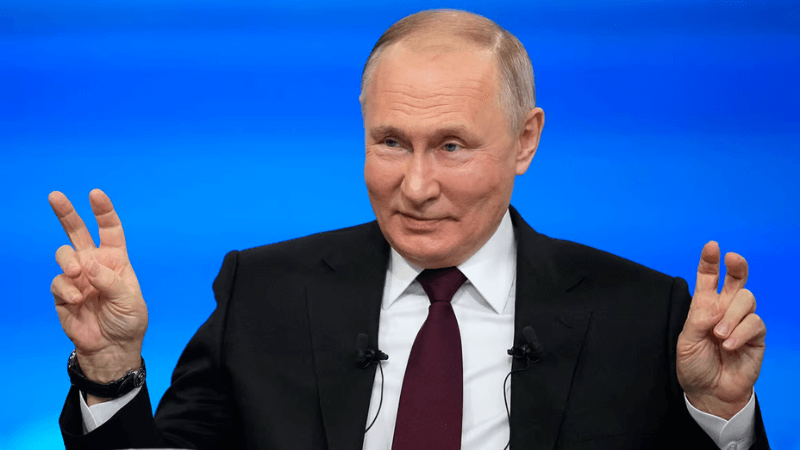
Vladimir Putin secured his fifth term as president with an overwhelming victory, claiming more than 87% of the vote. Despite criticisms of a lack of credible opposition candidates and claims of transparency, Putin asserted Russia's democracy surpasses that of many Western nations. Symbolic protests organized by supporters of deceased Putin critic Alexei Navalny, such as the "Noon against Putin" initiative, saw long queues of voters form in Russian cities and outside embassies abroad, although these protests were unlikely to affect the outcome.
At least 80 Russians were arrested, according to monitoring group OVD-Info, during the election period. Unlike Friday's sporadic attacks on polling stations, there were no reports of such incidents. Germany was among the Western countries who condemned the election, calling it a "pseudo-election" held under an authoritarian government characterized by violence, repression, and censorship. "The illegal holding of elections on Ukrainian territory" was denounced by Lord Cameron, the foreign secretary of the United Kingdom. Volodymyr Zelensky, the president of Ukraine, declared that "the Russian dictator is simulating another election". As his buddy Leonid Volkov put it last week after being brutally thrashed with a meat hammer while living in exile in Lithuania, "The percentages drawn for Putin have, of course, not the slightest relation to reality."
Russians were granted three days to cast their votes, with residents in Russian-occupied areas of Ukraine having even longer, in efforts to boost voter turnout. Despite reports of an election commission official being killed in Berdyansk and accounts of pro-Russian collaborators distributing ballot boxes accompanied by armed soldiers, Russian state TV channels celebrated the election outcome "This is an incredible level of support and unity around the figure of Vladimir Putin," said one correspondent excitedly, "and a signal to Western countries".President Putin was more subdued as he took questions from reporters, but he did hail Russia's presidential campaign as far more advanced than the US, citing Russia's use of online voting, which officials said brought in eight million voters.
"It's transparent and absolutely objective," Putin said, "not like in the US with mail-in voting... you can buy a vote for $10" . He has been in charge of Russia since 2000 and is now expected to remain in office until at least 2030. He is the Kremlin's longest-serving leader since Soviet leader Joseph Stalin. Golos, an independent watchdog, was not allowed to monitor the vote, but complaints of anomalies and pressure on public sector workers to cast their ballots in person or online have surfaced. While praising opposition activists for inspiring voters to cast more votes, President Putin condemned ballot tampering and threatened legal action against those responsible.
It was one month after the death of his most outspoken critic in an Arctic Circle prison cell that Putin mentioned Alexei Navalny by name for the first time.Mr. Putin reportedly acknowledged accusations that he had considered trading Navalny for prisoners imprisoned in the West, but only if his adversary never returned. This comment may have been used to refute popular allegations that he had Navalny dead. "I said I'm for it but, unfortunately, what happened happened. What can you do? That's life."
Yulia Navalnaya, the widow of Alexei Navalny, recounted waiting for six hours outside the Russian embassy in Berlin as part of a protest vote campaign. She mentioned writing her late husband's name on her ballot paper and expressed gratitude to everyone who participated, stating that it gave her hope. Similarly, a protest voter in London shared her experience of waiting for over seven hours before being able to cast her ballot. Activist and lawyer Lyubov Sobol, speaking from Washington DC, emphasized that protest votes wouldn't impact the Kremlin's results but stressed their symbolic importance. She highlighted solidarity among protesters. The Russian presidential election, she noted, lacked fairness, with the Kremlin exerting tight control over politics, media, and elections. Communist Party candidate Nikolai Kharitonov received only about 4% of the vote, with other candidates faring even worse. Kharitonov praised President Putin before the election, indicating the lack of serious opposition. Despite concerns about alternatives, millions of Russians voted for Putin's fifth presidential term. But that is purely because the Kremlin has removed any possible challenger from the political landscape. Opponents have either been jailed, or they have fled into exile, or they have lost their lives.
For a few short weeks there was a suggestion that an anti-war politician called Boris Nadezhdin might be allowed to stand. But last month he was ruled out by the election commission as increasing numbers of Russians warmed to his message and queued to register their support.