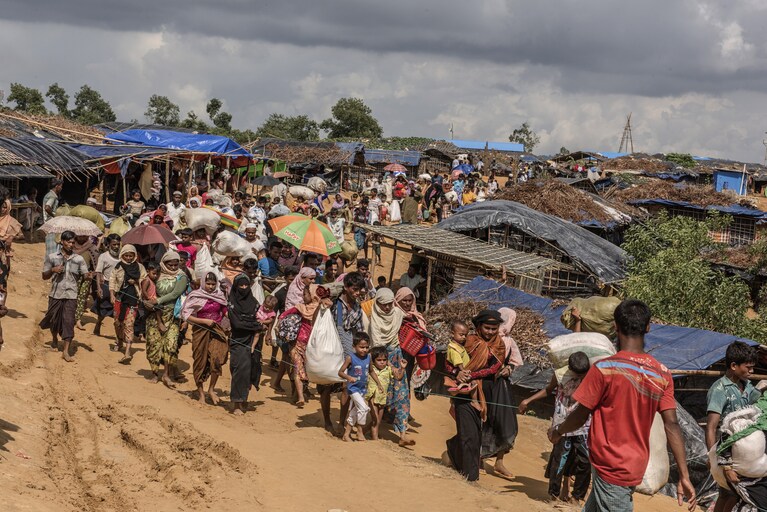
In the sweltering heat of Cox’s Bazar, children run barefoot over mud-slick paths between rows of tin-roofed shelters, their laughter fragile against the roar of the monsoon rains. For over a million Rohingya, this has been home for years ,a home built from fear, survival, and the memories of a Myanmar they can no longer return to. On World Humanitarian Day, their story is a stark reminder that the world’s most pressing crises are often lived in silence.
More than one million Rohingya, driven from Myanmar by waves of persecution and violence, remain stranded in overcrowded camps in Cox’s Bazar, living in limbo without citizenship, dignity, or a clear future. Their story is not isolated the UN counts over 120 million people worldwide as forcibly displaced, making the refugee crisis a defining humanitarian challenge of the century. From Sudan to Ukraine, Gaza to Afghanistan, the faces change but the suffering echoes the same.

For the Rohingya, injustice has been a constant companion. Stripped of basic rights in their homeland, denied safe return, and often portrayed as burdens in host countries, they exist in a state of suspended humanity. Aid groups warn that fatigue in donor capitals and shrinking relief budgets have left services stretched to the breaking point. Education, healthcare, even basic food supplies are now at risk of collapse in the camps.
Still, there are glimmers of global solidarity. Humanitarian agencies, despite funding shortfalls and political fatigue, continue to deliver lifelines. From emergency nutrition for children to legal advocacy at international courts, the effort persists to prevent the Rohingya crisis from being forgotten. This year’s UN theme Strengthening Global Solidarity and Empowering Local Communities.
But campaigners insist that aid alone is not enough. “World Humanitarian Day should be more than symbolic,” said one rights advocate in Dhaka. “It must be a wake-up call for justice, repatriation, and accountability. Refugees deserve more than pity they deserve a future.”
As the world pauses to mark this day, the stories of the Rohingya and other displaced peoples remind us that humanitarianism is not charity, but an obligation. The measure of the international community is not in words spoken at conferences, but in whether the world’s most vulnerable can one day live free, dignified, and at home.
BOB Post