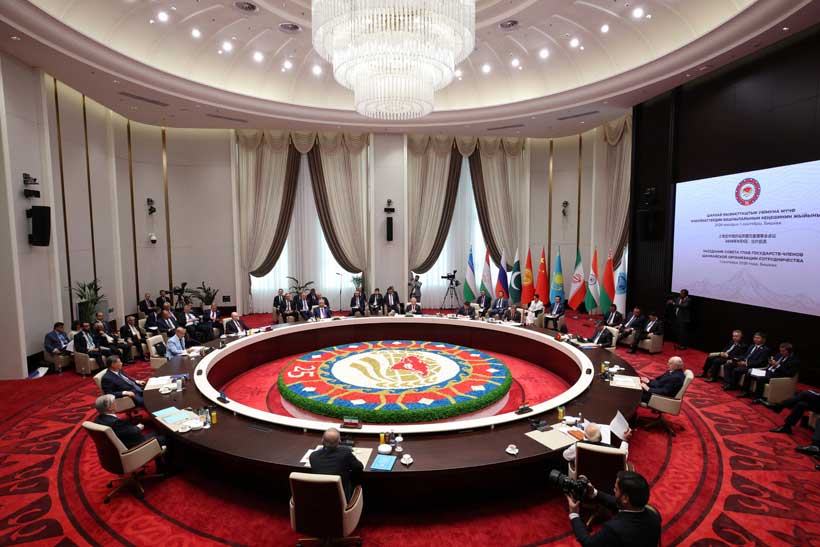
Leaders of the Shanghai Cooperation Organization (SCO) approved a broad package of institutional and sectoral measures at their summit in Bishkek on September 1, but failed to finalize the proposed SCO Development Bank, leaving one of the bloc’s most ambitious economic initiatives still under negotiation.
The 28 documents adopted at the summit included amendments to the SCO Charter, new regulations for its security institutions, and cooperation measures covering transport, digital technology, energy, climate and emergency response. The Bishkek Declaration also marked the organization’s 25th anniversary.
The summit produced a mixed outcome for host Kyrgyzstan. Bishkek secured political support for its proposal to strengthen the SCO’s response to natural disasters, while its bid to host the Development Bank remained unsettled. According to The Times of Central Asia, Kazakhstan subsequently put forward its own offer to host the bank’s headquarters, adding another layer to negotiations over the institution’s future.
The member states signed a protocol amending the 2002 SCO Charter and approved regulations for the Universal Center for Countering Security Challenges and Threats and the executive committee of the SCO Anti-Drug Center. They also endorsed programs targeting drug addiction, synthetic narcotics and transnational crime through 2030.
The institutional changes build on decisions taken at the SCO summit in Tianjin in 2025, when members agreed to establish the Anti-Drug Center in Dushanbe and a Universal Center based on the bloc’s existing counterterrorism structure in Tashkent.
The proposed Development Bank, however, remained the biggest unresolved economic issue. Although the Bishkek Declaration noted progress toward its creation, the summit produced no founding agreement, capital commitment or launch date.
Kyrgyz President Sadyr Japarov urged members to move toward a practical decision and proposed using the Tamchy Special Financial Investment Territory for joint projects. Bishkek had earlier offered to host the bank.
Kazakh President Kassym-Jomart Tokayev then presented a competing proposal, saying Kazakhstan could host the institution if member states reached consensus. He argued that the bank should finance infrastructure, technology and industrial development.
Beyond finance, the summit endorsed a 2026–2030 roadmap for ports and logistics centers and discussed the China-Kyrgyzstan-Uzbekistan railway as a major regional connectivity project. Kazakhstan also proposed an SCO transport strategy through 2035 and a unified digital transit platform.
Members approved an international information-security plan for 2026–2028 and initiatives on artificial intelligence, data processing and computing centers. They also adopted measures on biodiversity and green technology and signed a memorandum on climate cooperation.
On regional security, the SCO declaration strongly backed Iran’s sovereignty and condemned military strikes on Iranian territory. It also supported an independent, neutral and peaceful Afghanistan and called for stronger action against terrorism and drug trafficking.
Ukraine, meanwhile, was absent from the final declaration. Indian Prime Minister Narendra Modi addressed the war more directly during his bilateral meeting with Russian President Vladimir Putin, calling for a transition from continued fighting toward a cessation of hostilities.
The summit also highlighted deepening ties between China and Kyrgyzstan. Chinese President Xi Jinping and Japarov signed a joint declaration on their comprehensive strategic partnership as well as a treaty on permanent good-neighborliness, friendship and cooperation.
Pakistan will take over the SCO chairmanship for 2026–27 and is expected to host the next Council of Heads of State summit in Islamabad.
The Bishkek meeting therefore leaves the SCO with a strengthened institutional and security framework, alongside an expanded agenda on connectivity, technology and climate. But the Development Bank potentially the bloc’s most significant economic institution remains a proposal without a finalized structure, headquarters or timetable.
BOB Post