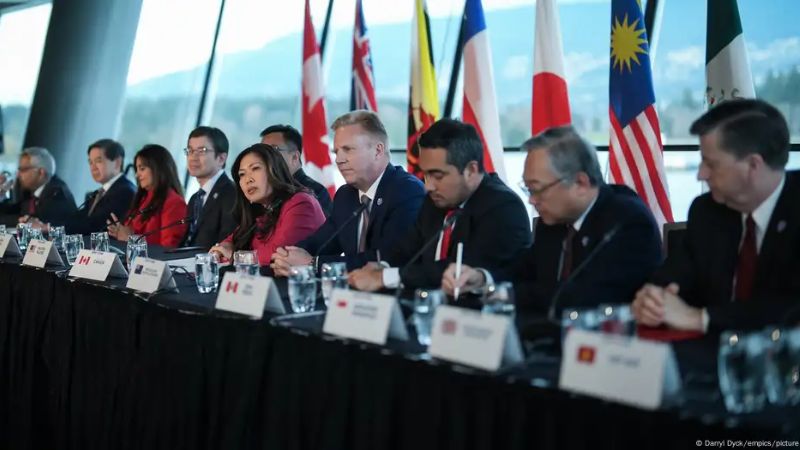
Britain became the first European nation to join the Comprehensive and Progressive Agreement for Trans-Pacific Partnership (CPTPP) on Sunday (November 15). This is what officials describe as the country’s most significant trade deal since leaving the European Union.
The UK’s accession to the trade bloc, which includes 11 other nations across the Indo-Pacific region, was formally signed into treaty last year and finalized this weekend. Government projections suggest that membership could provide a boost of up to £2 billion ($2.5 billion) annually to Britain’s economy.
The CPTPP, established in 2018, represents about 15 percent of global GDP and provides access to a combined market of over 500 million people. Current members include G7 nations Canada and Japan, alongside Australia, New Zealand, Brunei, Chile, Malaysia, Mexico, Peru, Singapore, and Vietnam. The bloc is viewed as a counterbalance to China’s influence in the region, though Beijing has also applied to join.
With total UK trade valued at £1.7 trillion in the 12 months to September 2023, joining the CPTPP builds on Britain’s efforts to establish new trade partnerships after exiting the EU’s single market in early 2021. Since Brexit, Britain has struck trade agreements with Australia, New Zealand, and Singapore, while also pursuing negotiations with Gulf countries and India. Talks with India, which had stalled, were recently revived by Labour Prime Minister Keir Starmer.
The deal was originally signed under the previous Conservative government in July 2023, with then-Business and Trade Secretary Kemi Badenoch hailing it as the most significant trade achievement post-Brexit.
However, challenges remain in securing other key trade agreements. A much-anticipated deal with the United States remains elusive, with prospects potentially diminishing further when Donald Trump assumes the U.S. presidency in January. Similarly, a hoped-for agreement with Canada has yet to materialize.
BOB Post