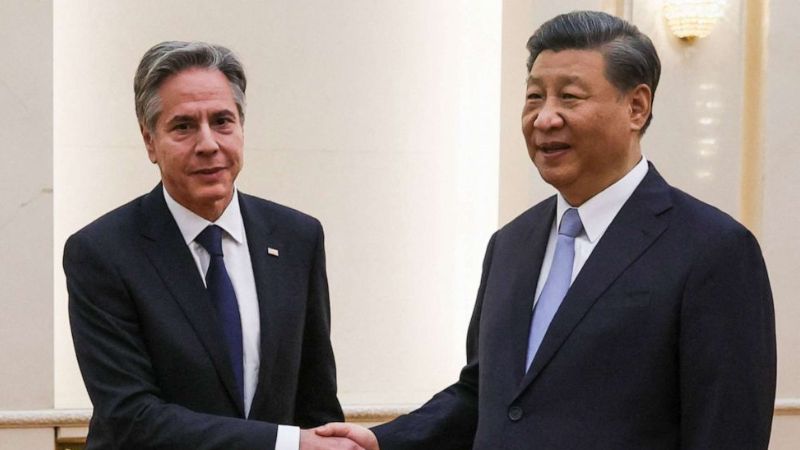
During a pivotal meeting in Beijing on Friday, Chinese President Xi Jinping and top US diplomat Antony Blinken engaged in discussions aimed at fostering a cooperative relationship between the world's largest economies, emphasizing the need for partnership over rivalry.
Blinken, on his second visit to China in less than a year, acknowledged progress in bilateral relations while urging Beijing to take more significant action on key issues, including its support for Russia.
In the ornate setting of Beijing's Great Hall of the People, Xi Jinping noted positive strides since his previous meeting with US President Joe Biden in November, stressing the importance of collaboration between the two nations.
However, Xi cautioned against what China perceives as US pressure on its economic activities, highlighting concerns such as semiconductor export bans and attempts to exert control over popular app TikTok.
Echoing Xi's sentiments, China's Foreign Minister Wang Yi warned Blinken of the potential consequences of US pressure, cautioning against actions that could lead to a downward spiral in bilateral relations.
A central point of contention raised during the talks was the status of Taiwan, with Wang emphasizing it as a "red line" that should not be crossed in China-US relations.
In addition to addressing economic and diplomatic concerns, Blinken expressed unease over China's support for Russia's military actions in Ukraine, warning of potential repercussions if Beijing fails to take action.
Despite these challenges, Blinken acknowledged areas of potential cooperation, including discussions on managing artificial intelligence, and highlighted China's role in regional stability, particularly in the Middle East.
Both sides emphasized the importance of managing their relationship responsibly, with Blinken stressing the need for clear communication to avoid misunderstandings and miscalculations.
The discussions come at a critical time for both nations, with Biden facing re-election pressures and China navigating economic challenges while seeking to maintain stability in its relations with the West.
While progress has been made on certain fronts, tensions persist, as evidenced by recent US actions targeting Chinese companies like TikTok.
As both sides navigate these complexities, the outcome of their discussions will have significant implications for global geopolitics and economic stability.
BOB Post