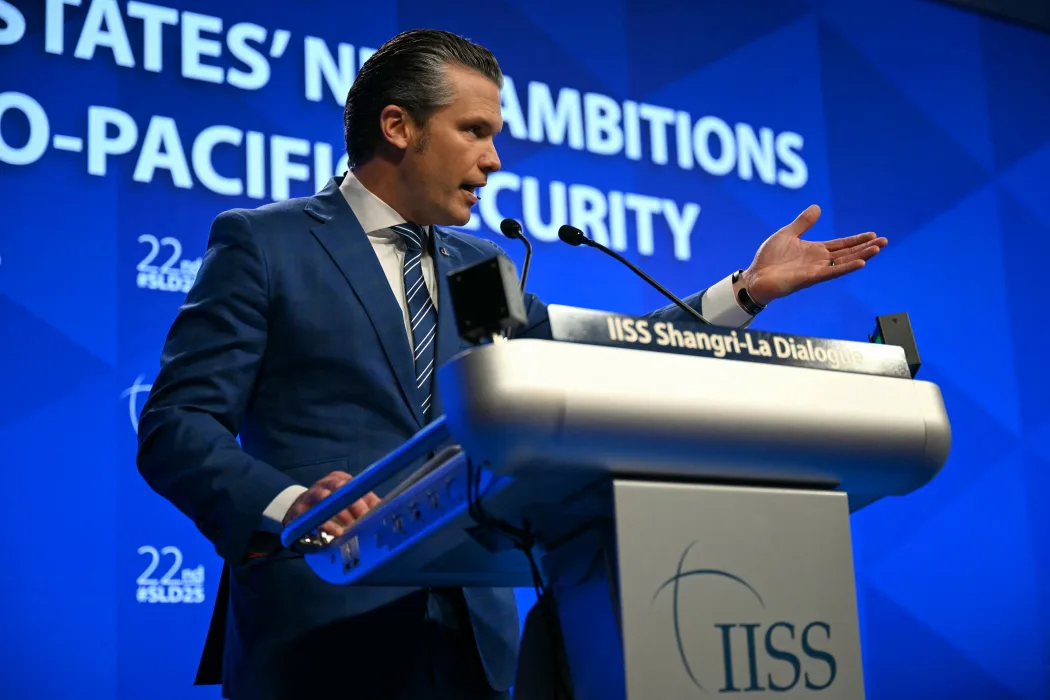
U.S. Defense Secretary Pete Hegseth on Tuesday(August 26) declared that Indo-Pacific allies are “stepping up” to meet a new global defense benchmark of 5 percent of gross domestic product (GDP), aligning with NATO’s commitment to reach the same target by 2035.
Speaking during a Cabinet meeting at the White House, Hegseth credited President Donald Trump’s administration with restoring deterrence both at home and abroad, stressing that the burden of security is no longer shouldered by Washington alone. “Whether it’s Europe … our allies (will be) paying 5 percent now. Our allies in the Indo-Pacific (are) stepping up to do the same,” he said. “That’s a recognition that American leadership is here.”

The Pentagon has recently underscored that the 5 percent threshold applies globally, signaling a major shift in U.S. defense strategy. The move reflects Washington’s drive to prepare allies for intensifying security challenges from China, North Korea, and regional flashpoints in the South China Sea and Taiwan Strait.
On Monday, South Korean President Lee Jae Myung pledged during a speech at the Center for Strategic and International Studies (CSIS) in Washington that Seoul would assume a more “leading” role in ensuring stability on the Korean Peninsula. While Lee did not detail specific figures, South Korea’s current defense budget 61.2 trillion won ($44.2 billion), roughly 2.32 percent of GDP falls short of the proposed target.
Defense analysts note that raising spending to 5 percent would represent a seismic shift in Asian security policy, potentially doubling budgets in countries such as South Korea and Japan. Advocates argue that the increase is necessary to counter North Korea’s advancing missile program and Beijing’s assertive military expansion. Critics, however, warn that the strain on national economies could stoke public opposition.
With NATO allies already committed to the 2035 goal, Washington’s push to extend the standard to the Indo-Pacific signals a long-term effort to integrate European and Asian security theaters under a single strategic framework. The move underscores U.S. insistence that allies take greater responsibility for deterrence while consolidating American leadership in shaping the global security order.
BOB Post