The global race for artificial intelligence is increasingly being fought through supply chains, financial networks and the movement of advanced semiconductors. A scandal involving Nvidia, a Singapore-based company and an alleged Chinese intelligence operative has brought one of the less visible dimensions of that contest into focus: how restricted US technology may reach Chinese companies through regional intermediaries, even as Washington tightens export controls.
At the centre of the controversy is Megaspeed, a little-known Singaporean company whose financial position expanded dramatically from $33 million in 2023 to $3 billion in 2024. Its rapid growth was reportedly driven by its role as an intermediary between US chipmaker Nvidia and Chinese technology giant Alibaba, raising questions about how advanced American processors were being channeled through Singapore's business networks.
The scandal has also drawn attention to Alice Huang, a businesswoman linked to Megaspeed and reportedly suspected by US authorities of having connections to Chinese intelligence. Huang has attracted additional scrutiny because of her reported personal and business relationship with Nvidia chief executive Jensen Huang. She was among Megaspeed's shareholders before the company changed ownership. However, the allegations surrounding her remain unproven, and Beijing has dismissed the espionage claims as groundless.
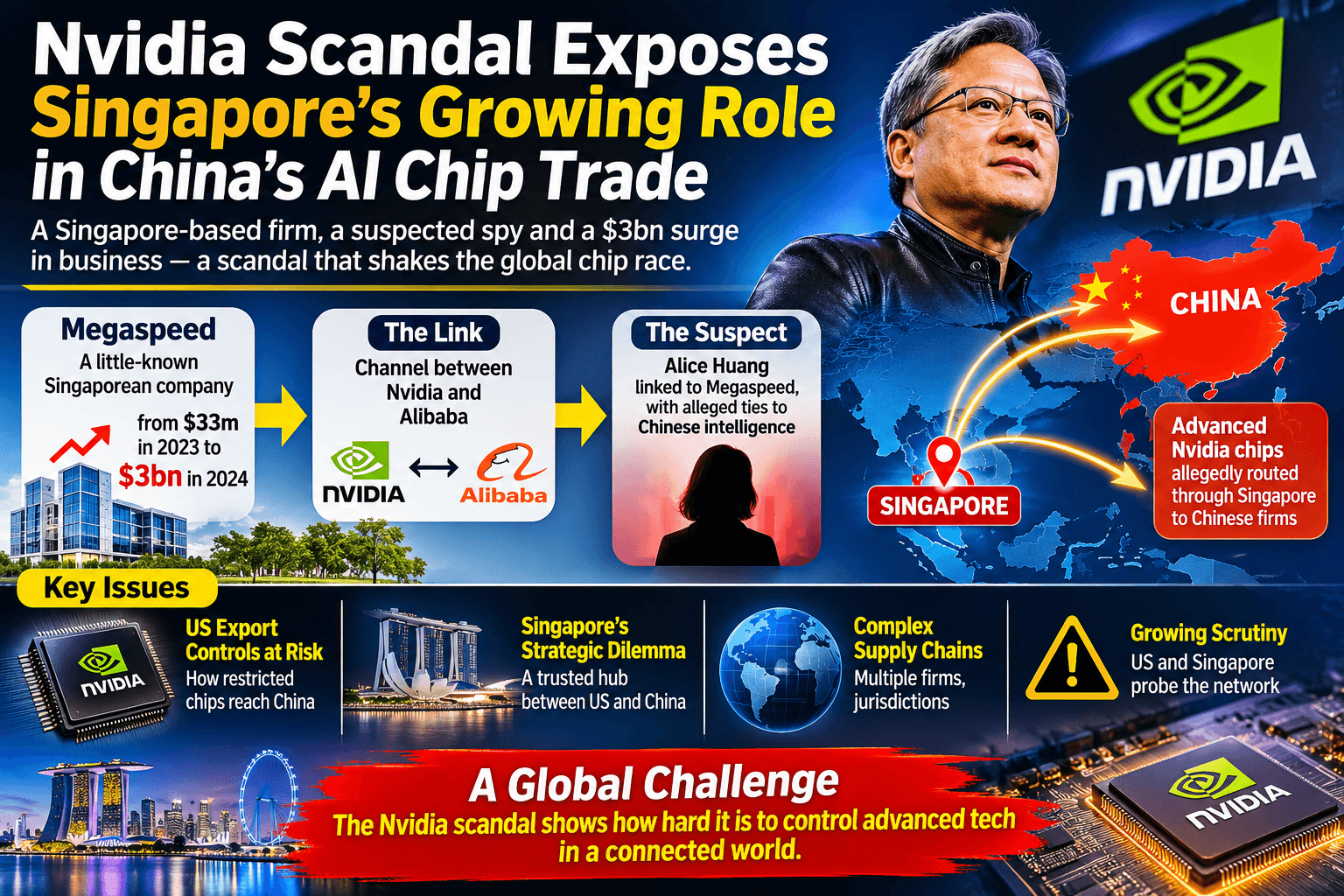
According to the Financial Times, Megaspeed leveraged its relationship with Alibaba to secure official cloud partner status with Nvidia, allowing it to purchase the American company's graphics processing units (GPUs) and provide computing services across Southeast Asia. Alibaba subsequently became its largest customer, while financial arrangements involving the Chinese technology group and Megaspeed's Malaysian subsidiary added another layer to the business relationship.
The case highlights a significant weakness in Washington's efforts to restrict China's access to advanced AI technology. US export controls are designed to prevent sensitive processors, particularly high-performance Nvidia chips, from reaching Chinese companies. But the complex structure of international trade allows equipment to move through third-party businesses, subsidiaries and data centre operators, making the ultimate destination difficult to establish.
Singapore has emerged as a particularly important point in this network. Although the city-state does not necessarily prohibit the transfer of advanced AI processors to Chinese businesses, companies involved in such transactions remain subject to applicable US export restrictions. Nvidia's financial disclosures illustrate the distinction between billing location and actual consumption: Singapore accounted for 18 per cent of the company's global revenue in fiscal 2025, although only around 2 per cent of its revenue came from products that physically entered the country.
The growing scrutiny is not limited to Megaspeed. In a separate investigation, Singaporean authorities raided 22 locations in February 2025 over suspected illegal transfers involving servers from Dell, Supermicro and Asus that may have contained Nvidia processors. The investigation resulted in charges against several individuals and companies over alleged fraud involving false declarations about the equipment's final destination. Aperia Cloud Services, another Singapore-based business associated with Nvidia's cloud partner network, also came under investigation.
Malaysia's expanding data centre industry adds another dimension to the issue. Its growing role as a regional computing hub has made it an important destination for infrastructure serving Chinese technology companies. Singapore-based businesses with Malaysian subsidiaries or commercial partners can therefore operate across a supply chain that spans multiple jurisdictions, complicating efforts to monitor where restricted processors ultimately end up.
For Washington, the challenge extends beyond identifying individual companies accused of violating export restrictions. It must also address a wider commercial ecosystem in which legitimate technology trade, cloud computing services and potentially illicit transfers can overlap. Singapore, meanwhile, faces the difficult task of protecting its reputation as a trusted international business and technology hub while maintaining economic relationships with both the United States and China.
The investigations have also raised concerns about whether tighter scrutiny in Singapore could simply push these transactions towards other regional markets with weaker oversight. As advanced chips become increasingly central to economic competitiveness and national security, controlling their movement is proving far more complicated than restricting their sale.
Ultimately, the Nvidia scandal is about more than the controversial connections surrounding one businesswoman or the investigations into a Singaporean company. It exposes the increasingly complicated geography of the AI race, where American technology, Chinese demand and Southeast Asian commercial networks intersect. Washington may control the export licenses, but ensuring that its most powerful chips do not reach prohibited destinations will require far greater oversight of the global networks through which they travel.
BOB Post