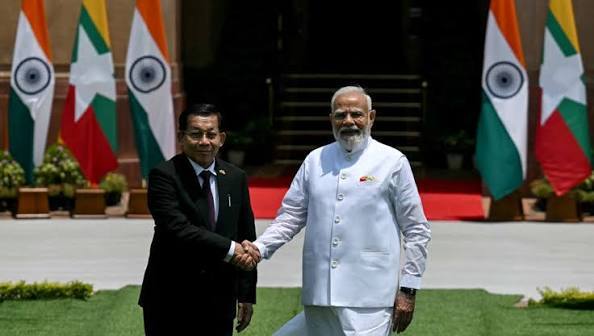
India’s Myanmar policy is becoming increasingly difficult to explain as simple pragmatism. New Delhi continues to deal officially with Myanmar’s military-backed government. From May 30 to June 3, 2026, Prime Minister Narendra Modi hosted Myanmar leader Min Aung Hlaing in India. On July 23, India and Myanmar also signaled closer cooperation on rare-earth mining, adding an economic dimension to an already strategically important relationship.
Yet at the same time, India’s northeastern state of Mizoram has developed increasingly close relations with the Arakan Army (AA), the rebel ethnic armed organization fighting Myanmar’s military and now controlling much of Rakhine State.
This presents a striking contradiction: India formally deals with one authority in Myanmar while increasingly adjusting to the authority of another.
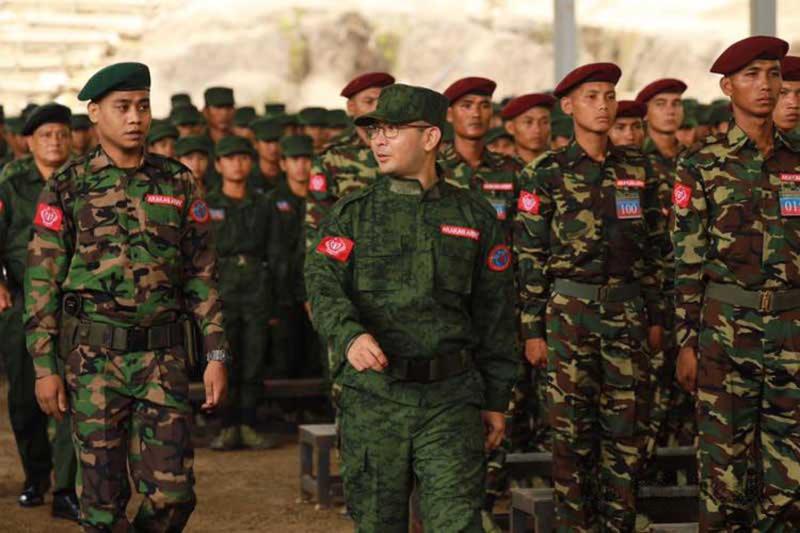
The question is not simply why India is communicating with the AA. Governments routinely engage armed groups that control territory during civil wars. The more important question is whether New Delhi’s growing dependence on the AA is turning tactical engagement into strategic overreach.
Kaladan Changed India’s Calculation
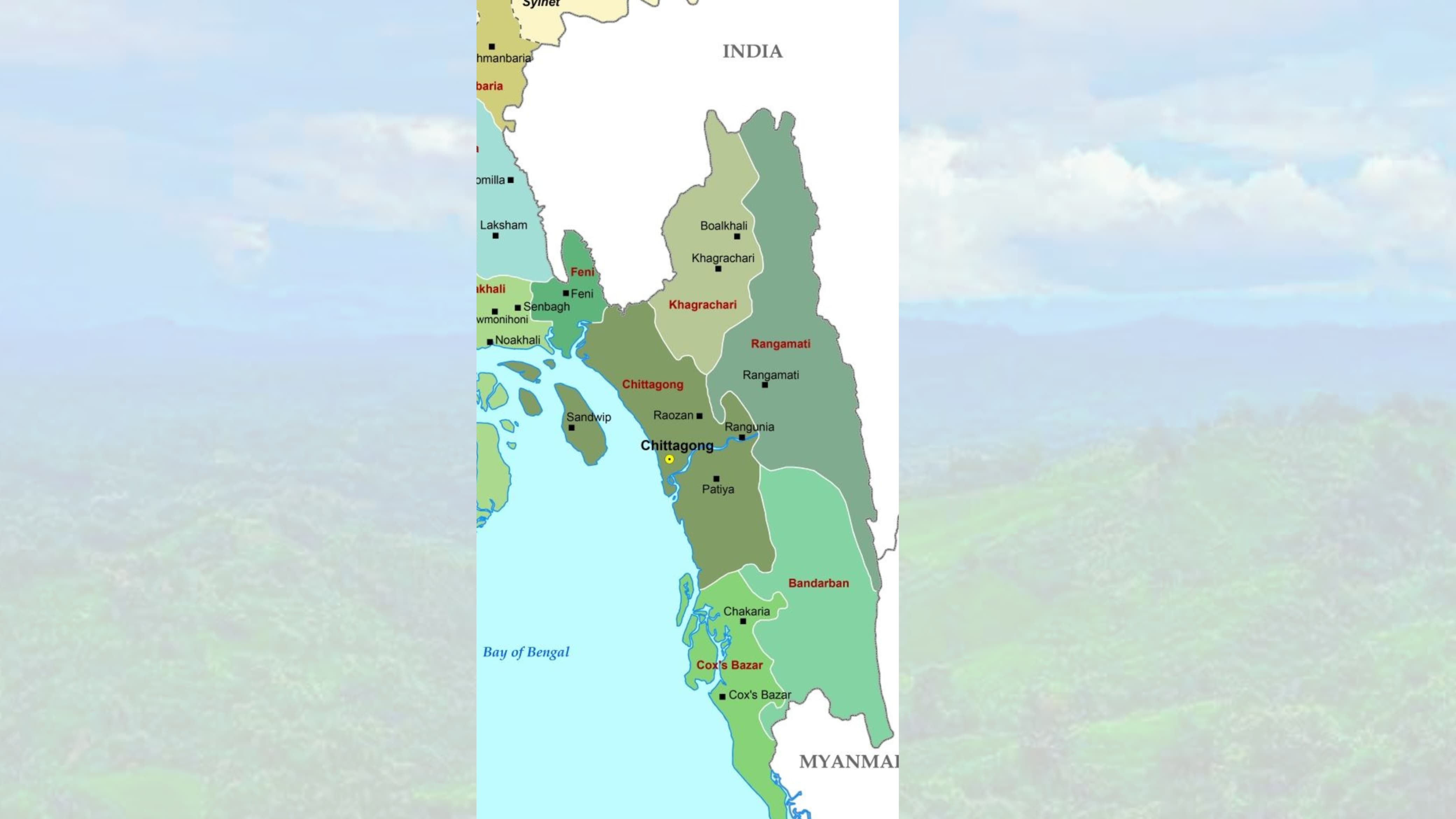
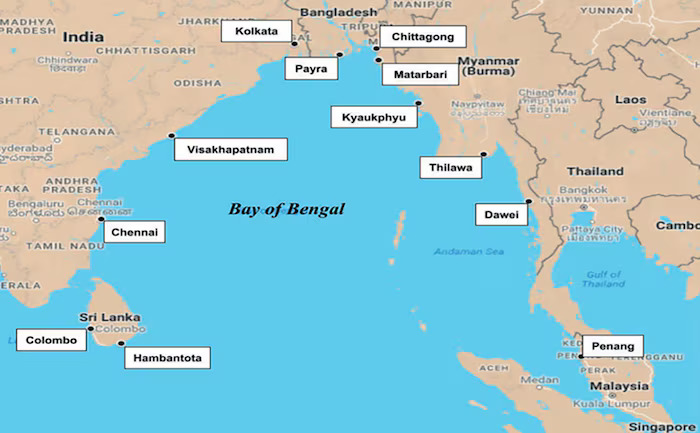
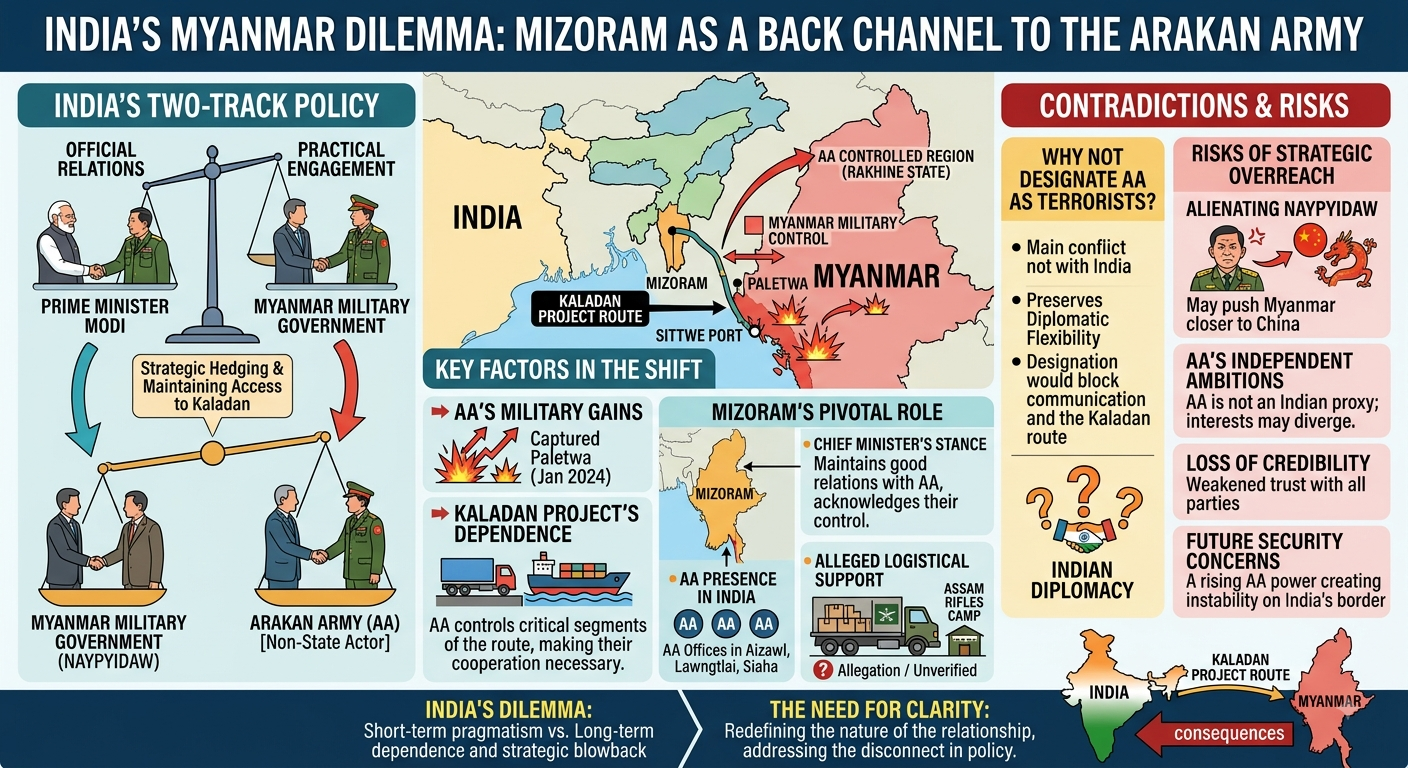
The project was designed to connect India’s northeast with the Bay of Bengal. Cargo would travel by sea to Sittwe, move along the Kaladan River to Paletwa and then continue by road towards Mizoram. For India, Kaladan is far more than an infrastructure project. It is a central component of the Act East Policy and provides an alternative route to the vulnerable Siliguri Corridor, the narrow land link connecting India’s northeastern states with the rest of the country. But the political geography of western Myanmar has changed dramatically since the project was conceived.
The original agreement was made with Myanmar’s central government. That government, however, no longer controls much of the territory through which the project must operate. The AA captured Paletwa in January 2024 and subsequently expanded its control across much of Rakhine. Paletwa is particularly important because it lies directly on the Kaladan route.
India therefore faces a basic strategic dilemma: its formal agreement is with the Myanmar state, but the organization with practical control over territory essential to the project is now the AA.
That reality has pushed New Delhi towards strategic hedging. It cannot afford to abandon Naypyidaw, but it also cannot ignore the armed organization controlling territory critical to one of its major strategic projects.
So India is maintaining channels with both sides. That may be pragmatic. But it is also creating a serious contradiction.
India’s Two-Track Myanmar Policy
Mizoram has become increasingly important to this two-track approach. Mizoram Chief Minister Lalduhoma has acknowledged maintaining good relations with the AA and recognized its control over Paletwa and other areas important to Kaladan. The AA, meanwhile, has indicated that the project can continue on the basis of mutual benefit. Together, these developments point towards a form of dual-track engagement.
New Delhi can continue speaking about Myanmar’s sovereignty and maintain formal relations with its central authorities while developing practical relations with the force exercising de facto control over territory important to India.
There is nothing inherently unusual about governments communicating with non-state actors during civil wars. The problem is the widening gap between India’s diplomatic position and its practical behavior.
If the AA is simply an armed organization challenging Myanmar’s territorial integrity, why is India increasingly treating it as an interlocutor? Conversely, if the AA has become an unavoidable authority in western Myanmar, why does New Delhi avoid clearly acknowledging the consequences?
India appears to want the benefits of both positions without fully accepting the costs of either. That is where strategic ambiguity can become a liability.
Why Mizoram Matters
Mizoram sits at the centre of this ambiguity. New Delhi could argue that contacts between Mizoram and the AA are simply the practical necessities of a border state. But that explanation becomes harder to sustain if the relationship increasingly involves political contacts, project coordination and institutional arrangements.
Foreign affairs and defence are Union responsibilities. Mizoram cannot independently conduct India’s foreign policy, while the Assam Rifles is a central security force. The source material points to several developments that therefore deserve scrutiny.
India’s Ministry of External Affairs records have referred to assistance under the headings of “humanitarian assistance” and “disaster relief medical aids” in connection with the AA. Officials associated with the Kaladan project have also been involved in contacts in Mizoram.
In February 2025, an AA focal person reportedly met M. Laikaw, the BJP-affiliated Chief Executive Member of the Mara Autonomous District Council in Siaha, and conveyed the organization's intention to establish an office there. Local sources later reported AA offices in Aizawl, Lawngtlai and Siaha.
The most serious allegation concerns December 2025, when local witnesses reportedly saw AA personnel receiving and transporting seven truckloads of military supplies from an Assam Rifles camp in Mizoram. This allegation requires independent verification and should not, by itself, be treated as proof of an official Indian policy.
But the broader pattern deserves attention. Taken together, these developments suggest something more than occasional border-level communication. They also raise the possibility of plausible deniability: Mizoram remains the visible point of contact while New Delhi can retain the benefits of engagement without formally recognizing the AA.
Why Has India Not Listed the AA as a Terrorist Organization?
This may be one of the most important questions surrounding India’s policy. The AA is not designated as a terrorist organization by India.
India has historically taken a hard line against armed organizations challenging state authority, particularly in its northeast. Several insurgent organizations operating in the region are formally designated under Indian law.
The AA remains outside that list.
One straightforward explanation is that the AA’s principal conflict is with Myanmar, not India. Its activities therefore do not fit neatly into the category of an organization waging an armed campaign against the Indian state.
But strategic calculation may also be involved. Designating the AA would reduce India’s diplomatic room for maneuver. Once an organization is formally classified as terrorist, maintaining practical communication with it becomes considerably more difficult. That would be inconvenient for India because Kaladan passes through territory controlled by the AA.
Not listing the organization therefore preserves strategic ambiguity. India does not recognize the AA as a government, but it can still communicate with it when circumstances require. That may be precisely the flexibility New Delhi wants.
Sovereignty at Home, Pragmatism Abroad
This creates a broader contradiction in India’s approach. India has consistently argued that armed groups cannot acquire political legitimacy simply by controlling territory. Yet in Myanmar, New Delhi is increasingly adapting to precisely that reality.
There is nothing inherently wrong with speaking to whoever controls territory. The problem begins when temporary engagement turns into strategic dependence. India may believe it is using the AA to protect Kaladan. The reverse may also be true.
The AA can use India’s dependence on Kaladan to increase its bargaining power with New Delhi. The more important the corridor becomes to India, the greater the leverage of whoever controls the territory through which it passes.
And the AA is not an Indian proxy. It has its own political ambitions, military structure and vision for Rakhine. India and the AA may share interests today, but there is no guarantee that they will share them tomorrow.
A Hedge That Could Alienate Everyone
India’s current approach is essentially a hedge. New Delhi wants to preserve its relationship with Naypyidaw in case Myanmar’s military-backed authorities remain important. At the same time, it wants working relations with the AA in case the organization becomes the dominant power in Rakhine.
It wants Kaladan. It wants to limit China’s influence. And it wants security along its northeastern frontier. These objectives could eventually collide.
Myanmar’s military authorities may conclude that India is strengthening an organization fighting against them. The AA may conclude that India wants its cooperation without offering meaningful political recognition. China, meanwhile, could exploit the resulting mistrust.
India could then develop a credibility deficit on both sides. Naypyidaw may not fully trust New Delhi. The AA may not consider India a reliable long-term partner. And India could still fail to secure permanent access to Kaladan.
That would be the worst outcome of strategic hedging: sacrificing trust without securing certainty.
The Risk of Strategic Overreach
India may call its approach realism. But realism also requires recognizing limits. A country does not overreach only by sending troops into another country. It can overreach diplomatically by becoming too deeply invested in political outcomes it cannot ultimately control. That is the danger facing New Delhi.
India may gain short-term access to the AA. But by helping normalize the organization as a strategic interlocutor, it may also contribute to the consolidation of a powerful armed authority along its northeastern frontier. That could eventually create new security problems for India.
There is also a wider geopolitical risk. India’s concern about China’s influence in Myanmar is understandable. But if Myanmar’s military authorities conclude that New Delhi is quietly accommodating their armed opponents, they may move even closer to Beijing.
That would be strategic blowback. India could weaken its relationship with Naypyidaw in an effort to contain China -only to create more room for China.
India Needs Clarity
New Delhi needs to define the relationship. If the AA is merely an armed organization challenging Myanmar’s sovereignty, India should explain the extent and nature of its practical engagement. If the AA has become a de facto authority, India should acknowledge that reality and accept the diplomatic consequences.
And if Mizoram is serving as a channel for sensitive engagement, New Delhi should not pretend that the entire relationship is simply the spontaneous initiative of a border state. The current policy may give India flexibility. But flexibility without a clear end-state can become strategic drift.
The Kaladan project was designed to expand India’s reach into Southeast Asia. New Delhi therefore needs to confront a harder question: Is India gaining strategic influence in Myanmar—or is it becoming strategically dependent on the very force whose growing power it is quietly accommodating? That is the contradiction at the heart of India’s Myanmar policy.
And if New Delhi continues to avoid confronting it, the Kaladan corridor may become more than a route into Southeast Asia. It could become a corridor through which the consequences of India’s strategic overreach return to its own doorstep.
Moyenul Hasan
Researcher and Lecturer