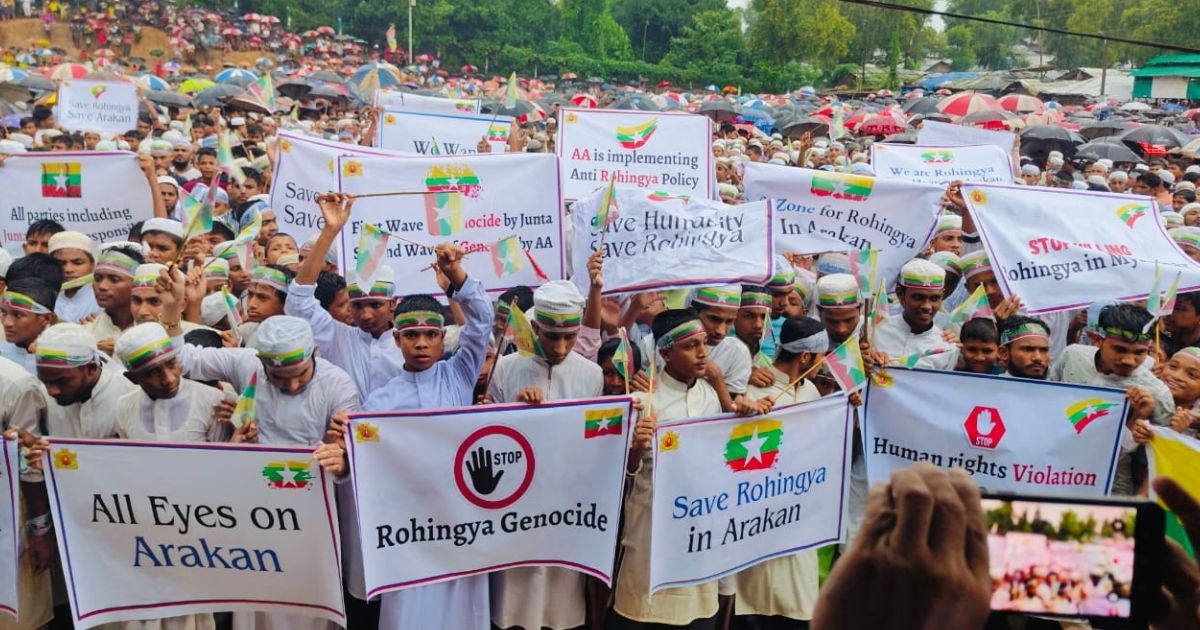
This is not an overnight massacre. The tyranny that has been going on for ages, the ultimate state of oppression. Since the beginning of 2016, tensions have been rising. It was finalized after one and a half years in August 2017. In the world media, one after the other, 'terribly beautiful' headlines-Myanmar Rakhine: Rohingya refugees drown as exodus mounts (BBC), Myanmar ethnic clashes between Muslim Rohingya and Buddhists sees exodus to Bangladesh (CBS), Bodies wash up on Bangladesh shore as Rohingya flee Myanmar (NY Daily). Seeing that a nation called Rohingya is disappearing from the world, the humanitarian eye of the world fell, but temporarily.
The Rohingya people, a Muslim ethnic minority in Myanmar, have faced extreme persecution and statelessness, making them one of the world's most oppressed groups according to the UN. Despite residing in Myanmar's Rakhine State for centuries, they lack official recognition and have been denied citizenship since 1982, leaving them vulnerable to various forms of exploitation and abuse.
Analysts offer diverse explanations for the Rohingya crisis. While ethnic and religious conflicts are often cited, analysts suggest geopolitical motives are at play, involving international actors and Myanmar's natural resources.
The history of the Rohingya conflict is rooted in centuries of ethnic tensions. Muslims began settling in Arakan (now Rakhine State, Myanmar) with the arrival of Arabs in the 8th century. This Muslim population later became known as the Rohingya, a term derived from the region's historical name, 'Rohan' or 'Rohang'.
During World War II, in 1942, the Japanese captured Myanmar, leading to conflict between local Rakhine Buddhists and Rohingya Muslims. Rohingya Muslims were at British side. Rakhine Buddhists killed about 5,000 Rohingyas, and in retaliation, the Rohingya killed around 20,000 Rakhine Buddhists. This violence forced at least 20,000 Rohingyas to flee to Bengal. Although the British regained control in 1945 with Rohingya assistance and promised a separate Muslim state, this promise was never fulfilled.
After Myanmar's independence in 1948, the Rohingya initially had political representation. At the time of the partition of India, the radical Islamist Mujahideen group that arose among the Rohingyas created chaos. They met Jinnah and said 'We want to be part of Pakistan, merge the eastern part of Rakhine with the eastern part of Pakistan'. Jinnah refuged this request. However, the 1962 military coup led by General Ne Win marked the beginning of severe persecution. The Rohingya Mujahideen's armed movements for a separate state further intensified their marginalization.
On October 15, 1982, Myanmar's military junta introduced a Citizenship Law recognizing 135 ethnic groups as full citizens, excluding the Rohingya. The government labeled them as illegal immigrants from Bangladesh, denying them citizenship and civil rights, thus rendering them stateless.
In late 2016, Myanmar's armed forces intensified their crackdown on the Rohingya, leading to a significant exodus in August 2017. Over 742,000 Rohingya fled to Bangladesh, escaping widespread violence and human rights violations. Currently, around one million Rohingya refugees live in Cox’s Bazar, Bangladesh, forming the largest refugee settlement in the world. The overcrowded camps pose severe challenges, particularly for women and children, who face high risks of violence, exploitation, and human trafficking. The monsoon season exacerbates these challenges, increasing the risk of waterborne diseases due to inadequate sanitation facilities.
Despite international efforts, repatriation remains a distant goal. Bangladesh, which has provided humanitarian asylum, faces environmental, economic, and security concerns due to the prolonged refugee presence. Bangladesh has repeatedly called for international intervention to ensure the safe repatriation of Rohingya refugees. Bangladesh proposals at the UN General Assembly included stopping ethnic cleansing in Myanmar, sending a UN investigative team, and creating a safe zone within Myanmar under UN supervision.
Progress on these proposals has been limited due to a lack of consensus among the international community, particularly within the UN Security Council. The 2023 Myanmar Humanitarian Needs and Response Plan received only a fraction of the required funding, highlighting the diminishing global attention to the crisis. Bangladesh diplomatic officials are constantly trying to solve this crisis at various levels. But the world is still very indifferent about it.
Meanwhile, there is growing concern about the locals. The Rohingya population now doubles that of the local population in Ukhia and Teknaf. Local people and development workers say that various aspects of the lives of the people of the region including agricultural land, labor market and education are affected by the pressure of the Rohingyas who came like a stream in a very short period of time. The salt farming land of the locals is now a refugee camp for the Rohingyas. Rohingyas are working cheaply in the local labor market due to lack of money. As a result, the local labors is not getting jobs anymore. The development workers say that the area's biodiversity and plants are at risk due to the construction of houses by cutting mountains and trees. Fishermen have been banned from fishing in the Naf River to stop the Rohingya from crossing. Therefore the fishermen of the area are affected. Buildings and grounds of local educational institutions are being used for shelter and distribution of relief to Rohingyas.
The attention of the international community towards Myanmar's Rohingya refugees in Bangladesh is decreasing. The response from various countries and donor agencies at the beginning of the crisis has steadily declined over the past few years. Officials of various international organizations and NGOs believe that since the beginning of the Russia-Ukraine war, there are indications that this aid will decrease further. Because, the attention of western countries is now focused on that. Some non-governmental organizations have started cutting back on various programs due to lack of funding.
According to the Inter-Sector Coordination Group (ISCG), a coordinating organization for humanitarian assistance in Rohingya camps, the financial assistance of the international community has been decreasing continuously since 2019.
In 2019, 920 million US dollars were asked for and 692 million US dollars were received. In 2020, $1058 million was asked for and $684 million was received. And in 2021, 943 million US dollars were asked for and 677 million US dollars were received. In 2022, aid came in at about 69 percent of demand. After the Rohingya took refuge in Bangladesh, international aid came in at its lowest in 2023, accounting for only 50 percent of the JRP requirement, or $438 million.
UN officials believe a reduction in food aid will make the Rohingya more desperate, fueling violence and unrest in the camps. Rohingya, especially children and girls, are at a higher risk of becoming victims of human trafficking. As a result, the organization is afraid of getting more Rohingya-laden boats in the sea in the coming days like last year.
Efforts to support the Rohingya continue through various UN agencies, providing essential services in Cox’s Bazar and on the island of Bhasan Char. However, the situation remains dire, with ongoing threats from Myanmar’s military and rebel groups like the Arakan Army, which forcibly recruit Rohingya for counter-insurgency operations.
The International Court of Justice is investigating the 2017 massacre, but Rohingya face new threats from the Arakan Army. This time, Myanmar's powerful rebel group Arakan Army is cracking down on rohingyas. Again, killings are going on there, houses are being burnt. Rohingya women, men and children are again waiting at the Bangladesh border in search of safe shelter. Human rights activists warn of the potential for further genocides if the international community continues to overlook the plight of the Rohingya. Without urgent intervention, the cycle of violence and displacement is likely to continue, perpetuating their suffering.
Aung Kyaw Moe, deputy minister for human rights in Myanmar's anti-junta National Unity Government, told Reuters about 70,000 Rohingya living in Maungdaw who were trapped as the fighting drew closer.
He said, "They have nowhere to run" .
The recent exodus of Rohingya started due to fighting in and around the town of Buthidaung, about 25 kilometers east of Maungdaw. Arakan Army captured the town of Buthidaung after intense fighting. During the battle, the Arakan Army targeted the Rohingya population. According to various media sources, many died and at least 40,000 Rohingya have been displaced by the Arakan Army attack. Last month, hundreds of thousands of Rohingya fled to neighboring Bangladesh for safety from the ongoing conflict. However, Bangladesh is not interested in sheltering any more refugees.
Accusations against the Arakan Army are mounting as reports surface that Rohingya are being forcibly recruited into the army by the Myanmar junta and sent to counter-insurgency operations in Rakhine villages. Human Rights Watch estimates that more than 1,000 Rohingya have been forcibly recruited into the army since February.
The American press has highlighted these facts in a report of the New York Times.
Again, the number of these killings is not known, but the human rights activists admit that the Rohingyas have been victims of another genocide. Their fear is that if the world ignores them like this, then these unfortunate Rohingyas will wait for the third and fourth genocide. Even if they look human, they will not become human.
Unruly hair, unkempt beard, a white panjabi over a knee-length lungi and wrinkled skin shows age and poverty, Muhammad Isamuddin came to Cox's Bazar, Bangladesh along with other refugees in 2017. Thought the situation would change in a year or two. He will go back to his own land. Even after 7 years passed, there was no chance to return. He want to go back to beloved birthplace before death, want to get recognition - I am a child of Myanmar. In the fall, his elusive dream merges every moment with the waters of the distant raging sea.
BOB Post