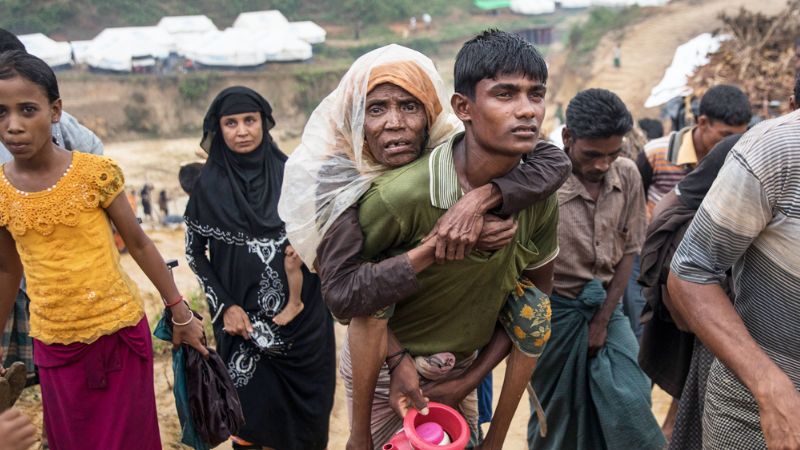
Bangladesh is considering revising its Rohingya policy after seven years of unsuccessful repatriation efforts and shifting political dynamics in both nations.
Since November of last year, Myanmar's ethnic rebel group, the Arakan Army (AA), has taken control of 11 out of Rakhine's 17 townships, including Maungdaw, a significant stronghold for the Rohingya. This development has positioned the AA as the de facto authority over more than 80% of Rakhine, including its 271-km border with Bangladesh.
Against this backdrop, Bangladesh's interim government, committed to upholding human rights and democracy, is reevaluating its approach to the Rohingya and Myanmar crisis. Officials from the foreign ministry have revealed ongoing deliberations about establishing semi-formal communication with the AA, recognizing its potential role in future repatriation efforts.
While exploring these new avenues, Dhaka intends to maintain its ties with Myanmar's official authorities and continue seeking support from regional powers like India and China, which have significant stakes in Myanmar.
"As a state, Bangladesh cannot maintain relations with a non-state actor like the AA," said Foreign Adviser Touhid Hossain at an event hosted by the Bangladesh Institute of International and Strategic Studies. "However, there can be semi-formal relations. In the coming days, AA will be the biggest factor in Rakhine State. We cannot do anything bypassing them."
Security and border control remain critical concerns, noted Sk. Tawfique M. Haque, director of the South Asian Institute of Policy and Governance. "You cannot control the border alone. You will need to engage with the AA -- be it for drug smuggling, human trafficking, or Rohingya repatriation," he said, adding that China and India are already engaging with the AA despite their formal ties with Myanmar's junta.
Rising Challenges in Rohingya Camps
Since July, approximately 60,000 more Rohingya have fled to Bangladesh, pushing the number of refugees in camps beyond one million. As resources dwindle, security concerns in Cox’s Bazar camps are escalating.
The UN Refugee Agency reported that of the $852.4 million sought for Rohingya support in 2023, donors provided only $455.7 million (53%) by September 30. Meanwhile, inadequate food rations are forcing 73% of Rohingya in Cox's Bazar to purchase food externally, according to Mohammed Mizanur Rahman, Refugee Relief and Repatriation Commissioner.
"This reality pushes the Rohingya to be involved in smuggling of yaba, human trafficking, and even arms smuggling," Rahman said. "Some members of the local community are also involved, creating a regional security threat."
Foreign Adviser Touhid Hossain emphasized the importance of education and skills development for Rohingya. "We have to try to help improve their skills so that when they return home, they can have a means of livelihood," he said.
A UN Conference and New Proposals
Chief Adviser Muhammad Yunus has appointed Khalilur Rahman as High Representative on the Rohingya Problem and Priority Issues Affairs. At Yunus' request, the UN is set to host a conference on the Rohingya crisis early next year.
"We want to bring back the international focus to the Rohingya crisis," said a foreign ministry official. Funding for improved services in Rohingya camps, including education and skills training, will be a key priority at the conference.
Yunus has also proposed a "safe zone guaranteed by the UN" for displaced Rohingya in Rakhine, which could serve as a platform for repatriation when conditions permit. "This can be an important aspect of discussion during the UN conference early next year," said Haque.
Exploring Strategic Partnerships
Officials in Dhaka and New York have acknowledged the lack of results from bilateral and regional engagements with Myanmar, China, and India since 2017. "Not a single Rohingya returned to Myanmar," one official said. The upcoming UN conference is expected to chart new policies and strategies to address the crisis.
Bangladesh is also exploring multi-layered relations with Myanmar, including engaging the National Unity Government and pursuing international accountability at forums like the International Court of Justice and the International Criminal Court.
Sufiur Rahman, Bangladesh's former ambassador to Myanmar, underscored the need for a "minimum deterrence" strategy. "Diplomacy without armament is like music without instruments," he said, adding that Bangladesh should also build a national consensus on Rohingya policy among political parties.
Rahman further highlighted the importance of supporting Rohingya leadership in Bangladesh and abroad to reclaim their rights in Myanmar, while assuring Myanmar's junta of non-involvement in Rakhine's security matters.
"This will be crucial to better handle the Rohingya crisis," he concluded.
BOB Post