Despite the military junta's internet blockade, the United Nations has reported alarming attacks on Rohingya civilians in Myanmar. The junta, struggling on the ground, is exacerbating ethnic tensions and forcibly enlisting Rohingya to combat local ethnic militias. This has led to a resurgence of sectarian violence in the country.
Recent atrocities in Myanmar’s Rakhine state signal a potential escalation in violence that could affect the entire nation once the civil war between ethnic militias and the military concludes. UN representatives have been vocal about "frightening and disturbing reports" of attacks on Rohingya civilians by both the military and the Arakan Army (AA), which controls much of Rakhine.
Tom Andrews, UN Special Rapporteur on Myanmar, expressed grave concerns over the situation. "The world seems to be failing a desperate people in their hour of peril while a hate-driven unnatural disaster unfolds in real-time in Myanmar’s Rakhine State," he said. Andrews highlighted reports of killings, enforced disappearances, and widespread arson in Northern Rakhine.
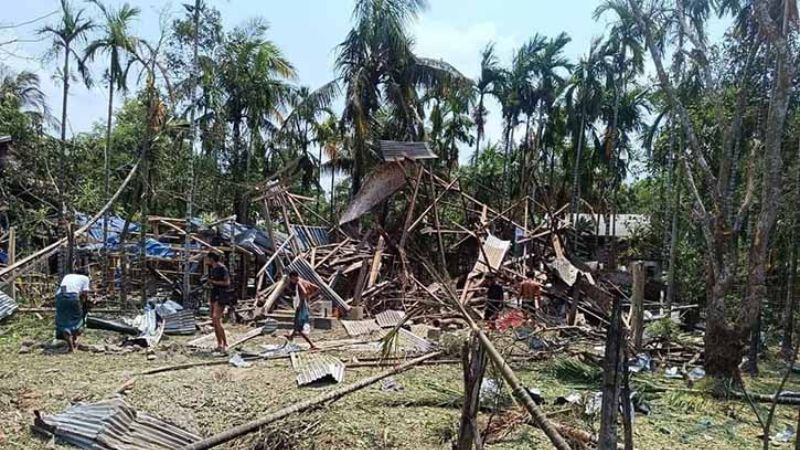
The UN reports that around 45,000 Rohingya have been displaced due to fires in and around Buthidaung, which have destroyed homes and crops. While the Rohingya blame the AA, the AA accuses the junta of conducting airstrikes. Satellite images reveal the extent of the fire damage, but the military-imposed internet blackout hinders the flow of reliable information.
Fighting has shifted to the town of Maungdaw after the AA captured Buthidaung, raising concerns about an expansion of violence. Liz Throssell, spokeswoman for the Office of the UN High Commissioner for Human Rights, warned of the "clear and present risks" of escalating conflict.
A report by the International Crisis Group (ICG) released earlier this month details rising tensions between the AA, which is predominantly Buddhist Rakhine, and the Muslim Rohingya. Violence erupted in Rakhine in November after the AA joined other ethnic militias in an offensive against the Myanmar army, ending a previously held ceasefire.
Since the military coup in February 2021, ethnic militias seeking greater autonomy have joined forces against the junta. The AA has always aimed for an ethnic Rakhine state, where about 600,000 Rohingya, denied citizenship by Myanmar, live. In 2017, the Rohingya faced a brutal military crackdown, prompting 750,000 to flee to Bangladesh.
In recent months, despite past persecution, many Rohingya have been conscripted into the army to fight the AA, with the junta facing a manpower shortage after three years of conflict. While conscription is often forced, some Rohingya have joined voluntarily, motivated by fear of the AA, promises of wages, and potential citizenship.
The Myanmar military has stoked inter-communal tensions to undermine the AA, even collaborating with the Arakan Rohingya Salvation Army, once labeled a "terrorist organization." AA leader Twan Mrat Naing’s derogatory references to the Rohingya as "Bengalis" have further inflamed the situation, attracting new fighters from Rohingya refugee camps in Bangladesh.
Reports indicate that thousands of potential fighters, including children, have crossed from refugee camps into Myanmar, with recruitment efforts intensifying recently. This forced enlistment has left many refugees too scared to leave their homes, with minimal intervention from Bangladeshi law enforcement.
Observers warn that AA attacks on civilians could drive more Rohingya into military ranks, perpetuating the cycle of violence. The current situation is reminiscent of the sectarian strife that plagued Rakhine between 2012 and 2017.
BOB Post