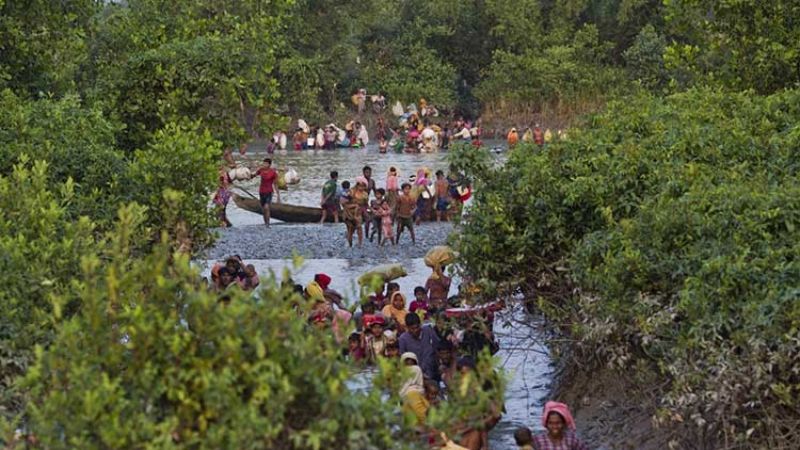
A drone strike near the Bangladesh border on Monday claimed the lives of over 200 Rohingya Muslims, forcing hundreds more to abandon their desperate attempts to flee. The attack, reportedly carried out by the rebel Arakan Army, has left thousands of Rohingya stranded in the fields, unsure of their next move, while others have reluctantly returned to their perilous hometowns.
Some, out of sheer desperation, have sought refuge in areas controlled by the very group accused of orchestrating the deadly strike. "The situation in Maungdaw is grim," says Nay San Lwin, co-founder of the Free Rohingya Coalition. "Many Rohingya see no other choice but to flee into Arakan Army territory, despite the dangers."
Maungdaw township in Myanmar's Rakhine state, close to the Bangladesh border, was the site of this latest atrocity. Harrowing footage circulating online shows the aftermath—lifeless bodies scattered across the mud, belongings abandoned in the chaos.
This assault is just the latest in a series of violent episodes targeting the Rohingya, who have been subjected to systematic persecution by Myanmar’s military for years. Fears are mounting that this attack signals a further escalation in the violence. The Rohingya people, who have already suffered so much, now face even more uncertainty.
After the Arakan Army took control of Buthidaung in May, a town with one of the largest Rohingya populations remaining in Rakhine state, thousands fled to nearby Maungdaw, hoping for safety. But the horrors have followed them. "The Arakan Army has been relentless," says Nay San Lwin. "In just the past few weeks, they've demanded that two villages, Sein Hynin Pyar and Hpon Nyo Leik, supply them with 100 young Rohingya men. The threat is clear—comply, or face the torching of your entire village."
Families are facing impossible choices. Some are paying whatever they can to keep their sons from being conscripted into the Arakan Army. Meanwhile, the violence continues unabated. Since June, at least 400 Rohingya have been killed in Maungdaw alone.
The humanitarian crisis is worsening by the day. With over 750,000 Rohingya already in Bangladesh after fleeing the 2017 military crackdown, the country is struggling to cope. The recent breakdown of a ceasefire agreement between the Arakan Army and Myanmar's military has left the Rohingya in an increasingly precarious situation, trapped between violence and an uncertain future.
BOB Post