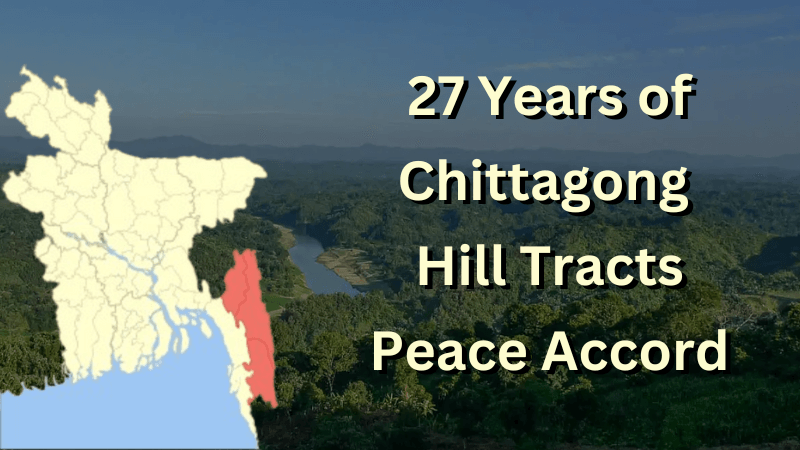
The Chittagong Hill Tracts (CHT) Accord was celebrated 25 years ago as a historic accomplishment and a ray of hope for an area plagued by decades of war. Signed on December 2, 1997. The Accord aimed to turn the unstable hills into a representation of harmony and development. However, as the anniversary approaches, the hope for peace remains tenuous, eclipsed by unmet expectations and rising tensions brought on by rebel violence and expanding geopolitical interest.
A Vision for Peace and Development
The CHT Accord was signed between the Government of Bangladesh and the Parbatya Chattagram Jana Samhati Samiti (PCJSS), a political group representing the indigenous Jumma people. The agreement sought to end decades of armed insurgency by promising the recognition of tribals land rights, regional autonomy through the CHT Regional Council, and the withdrawal of military camps.
For many, the Accord symbolized hope for a new era of harmony and inclusivity. However, a lack of full implementation, including delays in the resolution of land disputes and non-disarmament of insurgent factions, has hindered progress. Despite government claims of success, tribal leaders argue that the promises of self-determination and cultural preservation have largely remained on paper.
Rising Tensions and Insurgency
In recent years, the region has witnessed a resurgence of violence fueled by rival factions among tribal groups and growing activities of armed groups. Groups such as the United People's Democratic Front (UPDF) and splinter factions of the PCJSS have engaged in frequent clashes, leading to civilian casualties and insecurity. Adding to this turmoil is the emergence of new players like the Kuki-Chin National Front (KNF), an insurgent group representing the Kuki-Chin community, which has escalated the region's instability.
The KNF has gained notoriety for its alleged links to cross-border militancy and terrorist activities, raising alarms among security agencies. Reports suggest that the group operates training camps in remote areas, engages in extortion, and collaborates with other militant outfits. The KNF’s activities not only destabilize the region but also strain relationships between the tribal communities, exacerbating interethnic tensions.
The region has become even more unstable due to the growth of terrorist networks, which are frequently connected to transnational crime. Cross-border militancy, extortion, and arms trafficking reports point to a complicated network of criminal activity that presents difficulties for law enforcement and government. Local communities' anxieties have been heightened by the fear of these organization’s extortion, murder, and disappearances.
Geopolitical Complexity
The CHT’s strategic location bordering India and Myanmar adds another layer of complexity. The porous borders make the region susceptible to cross-border movements of militants and refugees, including the Rohingya population from Myanmar. These dynamics have drawn the attention of regional powers, turning the CHT into a stage for geopolitical maneuvering.
India, with its interest in maintaining stability along its eastern frontier, has occasionally raised concerns over militant activity in the CHT. Myanmar’s internal conflicts, coupled with China's increasing regional influence, add to the geopolitical stakes in this area. Analysts warn that external involvement could further polarize local dynamics and undermine efforts for sustainable peace.
The Way Forward
As the Accord enters its second quarter-century, the call for its full implementation grows louder. Indigenous leaders and rights groups emphasize the need for stronger political will to address land rights, ensure representation, and disarm militant factions. Meanwhile, civil society advocates stress the importance of inclusive dialogue and development initiatives to bridge trust deficits between the government and tribal communities.
The government, on its part, has reiterated its commitment to the Accord, pointing to ongoing infrastructure projects and socio-economic programs. However, experts warn that without addressing the root causes of unrest and engaging all stakeholders, these efforts risk being undermined by recurring violence.
The 27th anniversary of the CHT Accord is a reminder of its original vision: a peaceful, inclusive, and prosperous region. Achieving this requires renewed political will, robust governance, and a concerted effort to navigate the region’s complex socio-political and geopolitical challenges. For the people of the CHT, the Accord remains a beacon of hope, albeit one dimmed by unfulfilled promises and mounting tensions. Whether this milestone serves as a turning point or a missed opportunity will depend on the actions of all parties in the years to come.
Obaidur Chowdhury
BOB Post