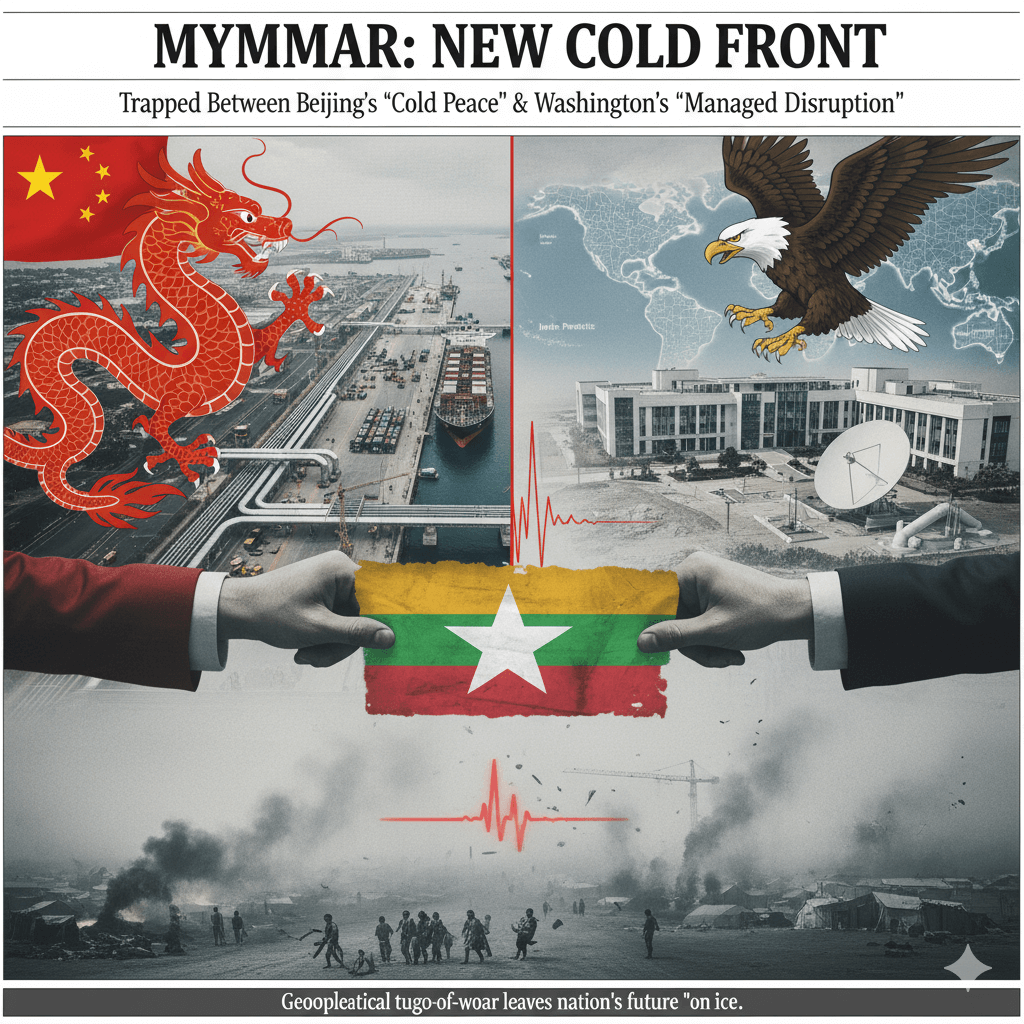
China has shifted from a passive observer to an active broker in Myanmar's civil war. It is engineering local ceasefires to quiet its border, but this leaves the nation's underlying political crisis dangerously unresolved.
This "ceasefire diplomacy," hammered out in discreet negotiations since late 2023, is not about lasting peace, analysts warn. Instead, it’s a pragmatic strategy of containment designed to protect Beijing’s vast economic interests and cement its regional dominance, creating a fragile "cold peace" while leaving Myanmar's deep internal fractures to fester.
Beijing’s hand was forced in late 2023 after the Three Brotherhood Alliance (3BHA) launched "Operation 1027," seizing strategic towns and border gates, and crippling vital trade networks. In response, China leveraged its longstanding ties with ethnic armed organizations (EAOs) to broker truces, such as the January 2024 agreement in northern Shan State and renewed understandings by October 2025.

The primary goal, observers note, is stability for China’s own assets securing its oil and gas pipelines, rare earth mineral access, and, most critically, the Kyaukphyu deep-sea port, a key piece of its global trade ambitions.
"Beijing is acting as a conflict manager, not a peacekeeper," said a regional security analyst familiar with the talks. "It is freezing a war it has no intention of ending. This is border management, not reconciliation."
These truces are geographically limited and purely transactional, focused on reopening trade routes while pointedly avoiding the core political questions of the junta's legitimacy or the role of the exiled National Unity Government (NUG). For civilians on the ground, the pause in fighting has brought tangible, if temporary, relief. But politically, it has provided breathing room for Myanmar's military, reinforcing its authority while marginalizing the broader resistance movement.
A New ‘Cold Front’
China's assertive new role has sent shockwaves through the region, sidelining traditional diplomatic players and sparking a new geopolitical contest with Washington.
India, whose "Act East" strategy depends on a stable Myanmar as a land bridge to Southeast Asia, has seen its own flagship projects, like the Kaladan transport corridor, disrupted. New Delhi now finds itself in a delicate balancing act, forced to hedge against Beijing's expanding influence.
Meanwhile, ASEAN and its member states, like Thailand, have been effectively marginalized. While Bangkok quietly welcomes the reduced violence on its border, it remains uneasy about China's growing monopoly over regional crisis management.
This power vacuum is being filled by the United States. Washington is quietly widening its footprint as part of a broader Indo-Pacific recalibration, viewing Myanmar as a new front in its rivalry with Beijing.
A massive new U.S. consulate complex nearing completion in Chiang Mai, Thailand, is widely seen by observers as an intelligence and coordination hub intended to monitor developments in both northern Myanmar and southwestern China.
For Washington, the strategic prize is complicating China’s "Malacca bypass" the crucial corridor running from Yunnan to the Kyaukphyu port, which allows Chinese trade to avoid the contested South China Sea.
"What we are seeing is a duel of competing strategies," the analyst added. "Beijing is practicing 'managed stability' to protect its investments. Washington is countering with 'managed disruption' to prevent China from controlling the board."
For the people of Myanmar, however, true peace remains a distant prospect. The war has not ended; it has merely been put on ice, with the nation's future trapped between the strategic interests of two global powers.
BOB Post