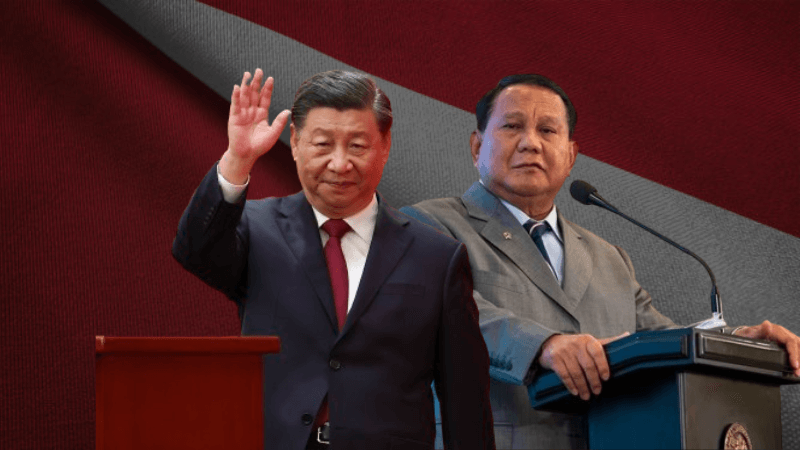
In what seems to be a shift in stance, Defense Minister Prabowo Subianto, formerly a vocal critic of China, is poised to clinch victory in Indonesia's presidential election. Analysts suggest that this anticipated win is unlikely to trigger significant alterations in the country's relationship with Beijing.
Nevertheless, concerns regarding labor safety, environmental degradation associated with Chinese investments, and Beijing's claims in the South China Sea could potentially strain the stability of this rapport.
Under President Joko Widodo's tenure, China burgeoned into Indonesia's principal trading partner, capitalizing on the nation's abundant resources. Widodo, often referred to as Jokowi, has actively encouraged China to ramp up investments in Indonesia, which has become a pivotal player in the Belt and Road Initiative.
China has poured billions into backing major infrastructure projects in Indonesia, such as the Jakarta-Bandung High-Speed Railway, inaugurated in October, and the Cirata, Southeast Asia's largest floating solar power venture, fully operational since last year.
"I don't think there will be a dramatic change in relations with China," asserted Faisal Nurdin Idris, a lecturer at the department of international relations at UIN Jakarta, speaking to VOA Mandarin Service. “Jokowi has built a strong relationship economically with China.”
During his previous presidential bid in 2019, Prabowo attempted to capitalize on public resentment toward Beijing by criticizing Jokowi's cozy ties with China, insinuating that Chinese laborers were usurping local jobs. However, in recent speeches, Prabowo has expressed a desire to foster amicable relations with both the U.S. and China concurrently.
Addressing a forum at the Center for Strategic and International Studies in Jakarta last November, he lauded Washington's historical role in pressuring the Netherlands to acknowledge Indonesian sovereignty in the 1940s and commended China's economic achievements.
Despite their developmental advantages, Chinese investments in Indonesia haven't been immune to controversy.
Teuku Rezasyah, associate professor in international relations at Padjadjaran University, highlighted several accidents and environmental incidents at Chinese-owned facilities, which have triggered discontent among locals.
"This is a problem that Prabowo must carefully consider before taking office," cautioned Rezasyah.
Last year, an explosion at a Chinese-financed nickel processing plant in Indonesia's Morowali Industrial Park claimed 21 lives. This incident marked the third fatal event at a Chinese-owned nickel smelter in Central Sulawesi that year, prompting hundreds of Indonesian workers to protest at the factory. This week, police named two Chinese citizens as suspects.
Prabowo is cognizant of the challenges posed by certain investment projects and has until his late-October inauguration to devise solutions, noted Teuku.
Beyond Chinese investment, Prabowo's approach to sovereignty issues between Indonesia and China will be closely monitored.
Similar to several Southeast Asian nations, Indonesia contests China's expansive claims in the South China Sea, including portions within Indonesia's recognized exclusive economic zone. However, unlike confrontations witnessed between China and the Philippines or Vietnam, the dispute hasn't escalated.
Yohanes Sulaiman, associate professor in international relations at Universitas Jenderal Achmad Yani, Cimahi, Indonesia, suggested that Prabowo might adopt a more assertive stance if Beijing continues its military buildup in the South China Sea.
"His response will depend on what China does," Sulaiman remarked. “If there are too many controversies, then you can expect, above all, that we are kind of escalating.”
Faisal Nurdin Idris believes that Prabowo might initially engage in discussions on South China Sea matters with other ASEAN nations embroiled in sovereignty disputes with China, with the hope of presenting a united front against Beijing.
BOB Post