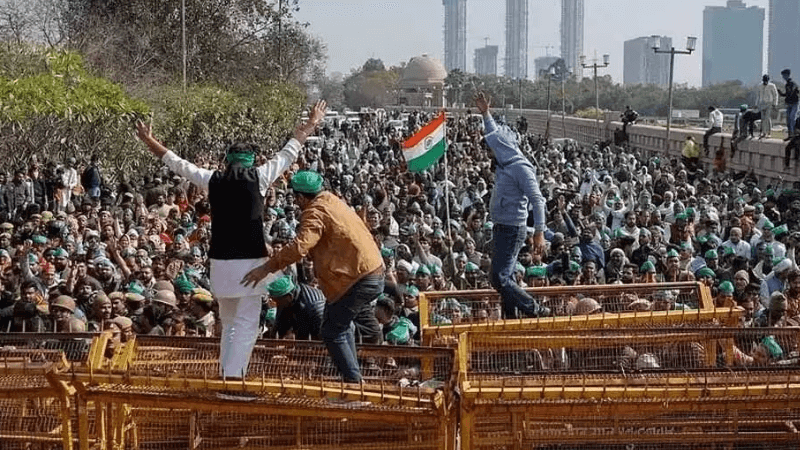
Ignoring Article 144, the farmers of India have started the 'Delhi Chalo' road march. One of the demands that farmers' organizations are taking to the streets of Delhi is that the government should provide a legal guarantee of the minimum support price for the crop. A demand has also been made to give the minimum support price of the crop in accordance with the Swaminathan Commission's proposal. At the same time, the farmers have also demanded to waive off all agricultural loans.
To prevent this road march of farmers, the police has already issued Section 144 for a month to provide security to the capital Delhi.
Besides, the agitators demanded dismissal of the cases filed against the farmers during the 2020-21 protest. The demand for repeal of the Electricity Act 2020 and compensation for the farmers killed in Lakhimpur Kheri has been informed. A meeting between the Center and farmers' organizations on the issues on Monday night was inconclusive. According to sources, the meeting took place after 11 pm on Monday. The two Union Ministers assured the farmer leaders about repealing the Electricity Act 2020. It was also informed that the case filed against the farmers in the case of Lakhimpur Kheri in Uttar Pradesh will be withdrawn. But the two sides could not come to a firm decision on the three main demands of the farmers — minimum support price for crops, farm loan waiver and implementation of Swaminathan Commission recommendations. As a result, the farmers are steadfast in their determination, said a representative of the farmers. He alleged that two years ago, the Center had promised to settle half the demands of the farmers, but nothing was done. He alleged that the government wasted time even though the farmers tried to solve the problem peacefully.
Farmer leaders like Jagjit Singh Dallewal of Sammilita Kisan Morcha (Non-Political) and Sarwan Singh Pandher of Kisan Mazdoor Sangram Committee expressed doubts about the government's commitment to meet their demands.
It should be noted that the administration has been active in stopping farmers from traveling to Delhi. Haryana's Manohar Lal Khattar government hastily built temporary jails in two big stadiums. Both the Chaudhuri Dalbir Singh Indoor Stadium in Sirsa and the Guru Gobind Singh Stadium in Dabwali have been converted into temporary jails. According to sources, if any untoward situation arises while the farmers are proceeding with the procession, they will be arrested and kept in jail. A huge police force has been deployed along the Haryana border. Water cannons are deployed. To prevent protesters from entering Haryana from other districts, surveillance has been stepped up at the state borders. An additional 50 companies of police have been deployed by the state government. The Haryana government has also issued a notification announcing the suspension of internet services.
Delhi is also wary of farmers' march. Section 144 has been imposed in Delhi ahead of the farmers' programme. Section 144 will remain in effect in the capital till March 12. Security has been beefed up at Singhu, Gazipur and Tikri borders. Barricades have been put up at places to block the border. Concrete walls have been lifted and barbed wire fences and nail plates installed. A large police force is deployed. Opposition parties and farmers' organizations have criticized the Centre's move to bar farmers from entering Delhi.
BOB Post