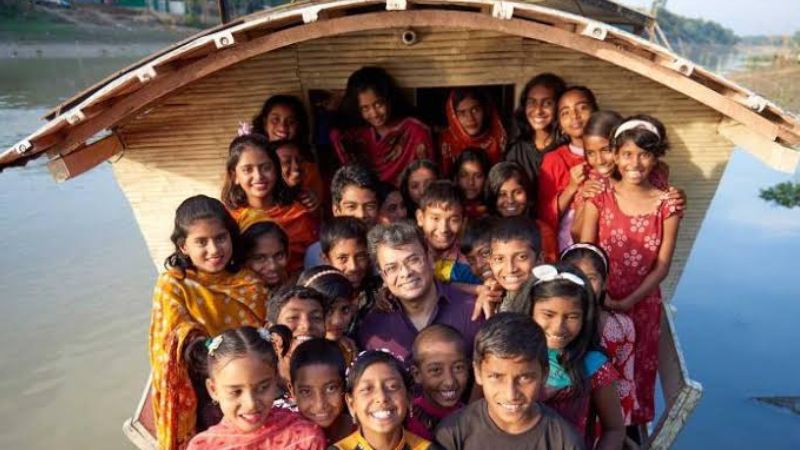
Architect Mohammad Rezwan, the visionary behind the world’s first floating schools, has been honored as a Yale World Fellow for his groundbreaking work in education and climate adaptation. His organization, Shidhulai Swanirvar Sangstha, pioneered the idea of solar-powered floating schools in 2002, ensuring uninterrupted education for children in Bangladesh’s flood-prone Chalan Beel region.
Rezwan’s recognition by Yale University, which annually selects global changemakers for its prestigious leadership fellowship, highlights the power of small initiatives in driving large-scale social change. His floating school model has since expanded beyond education to include floating libraries, healthcare centers, vocational training hubs, playgrounds, and even floating farms—all serving as lifelines for communities affected by climate change.
The impact of his innovation is profound. The Government of Bangladesh has officially included the floating school model in its National Adaptation Plan (2023-2050), and the concept has already been replicated in eight countries across Asia and Africa.
As a Yale World Fellow, Rezwan will engage with students at Yale University through lectures and mentorship, contributing to global discussions on climate resilience and educational innovation. He will also conduct research and share Bangladesh’s experience in tackling climate and social challenges through innovative grassroots solutions.
Rezwan expressed his gratitude, stating: “This recognition is for all the resilient people of Bangladesh who continue to inspire us. It proves that innovative solutions can emerge from anywhere in the world. I hope this honor will help expand the reach of our floating school model, furthering climate adaptation and education at a global level.”
A Small Initiative, A Global Impact
Rezwan’s story exemplifies how a simple yet effective idea can lead to transformative social change. His floating schools started as a local response to an urgent problem—children missing school due to floods. Today, they serve as a model of climate-smart education, offering hope to vulnerable communities worldwide.
His journey underscores the power of grassroots innovation in addressing complex global issues like climate change, education access, and rural development. What began with one floating school in Bangladesh has evolved into a global movement, proving that big changes often start with small steps.
BOB Post