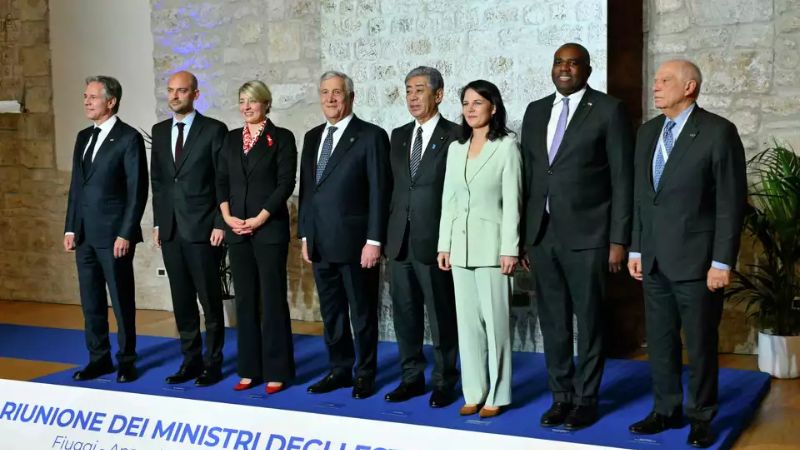
The foreign ministers of the Group of Seven (G7) nations have reaffirmed their commitment to addressing shared challenges in the Indo-Pacific region during discussions held on Tuesday (26 November) in Fiuggi, Italy. The meeting included counterparts from India, the Philippines, South Korea, and Indonesia.
Japanese Foreign Minister Iwaya Takeshi emphasized Japan’s intention to collaborate with like-minded nations to uphold a free and open international order grounded in the rule of law. The ministers expressed concerns over China's increased maritime activities in the East and South China Seas, which they see as destabilizing the region.
While acknowledging these challenges, the G7 stressed the importance of constructive and stable relations with China. The group emphasized the need for engagement to manage differences and expressed readiness to work with Beijing on addressing global issues.
Minister Iwaya also urged G7 members to maintain unity in responding to North Korea's nuclear and missile programs, which pose a significant security concern for Japan. Additionally, he sought international cooperation to resolve the decades-old issue of Japanese citizens abducted by North Korea. The attending nations voiced their support for these efforts.
Indian External affairs minister Jaishankar noted “A warm meeting with DPM & FM @Antonio_Tajani of Italy today. Discussed opportunities in technology, innovation, clean energy, fertilizers, railways, and investments. Also exchanged perspectives on IMEC, Ukraine, and the Indo-Pacific. The recently announced Joint Strategic Action Plan guides our activities. Look forward to welcoming him in India in 2025”, in a post on X.
The ministers also discussed reports of North Korean soldiers being deployed to Russia, allegedly to assist in its military actions against Ukraine. The countries expressed mutual concern about the use of these troops in combat roles.
The meeting underscored the importance of collective action and cooperation in promoting regional stability and addressing global challenges. The Indo-Pacific and Bay of Bengal regions are crucial due to their strategic, economic, and geopolitical significance. For India, the Bay of Bengal is a gateway to Southeast Asia, central to its Act East Policy and crucial for maritime security, trade, and energy supply. Similarly, Indonesia, as an archipelagic nation straddling the Indo-Pacific, relies on these waters for economic connectivity, resource exploitation, and national security. They are also hotspots for geopolitical competition, with nations vying for influence and control amid rising tensions over territorial disputes and maritime security
Obaidur Chowdhury
BOB Post