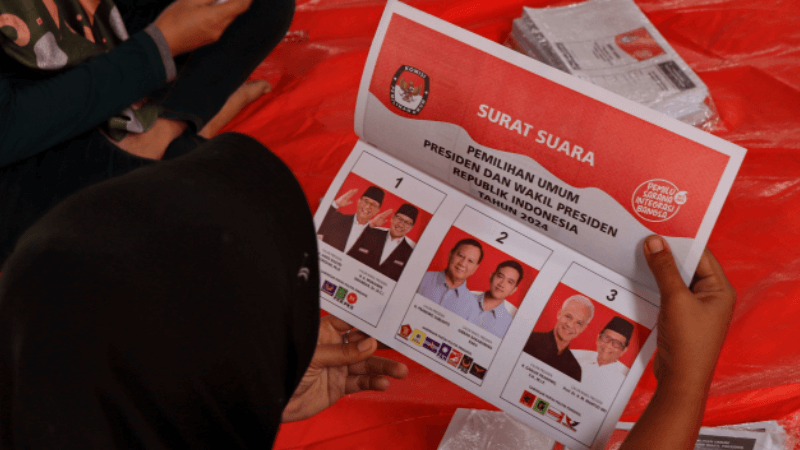
Ten Millions of Indonesians commenced voting on Wednesday. In the world's biggest single-day election, almost 259,000 people are running for 20,600 positions in Indonesia. But what everyone is watching closely is the race for the presidency and what will happen to Jokowi's big plans after leading one of Asia's largest and fastest-growing economies for ten years.
There are three main contenders: Ganjar Pranowo and Anies Baswedan, who are former governors, and Prabowo Subianto, who used to be in special forces and was a close associate of Indonesia's former leader Suharto in the 1990s.
Approximately 205 million people are eligible to vote in the complex simultaneous presidential and legislative elections across three time zones, constituting one of the world's most intricate single-day ballots.
Voting began in eastern Indonesia, including the restive Papua region, and will conclude at 1 p.m. Jakarta time. Indonesians are choosing national, provincial, regional, and city representatives, alongside a new president and vice president, managing five ballots concurrently.
Over 800,000 polling stations have been set up across the archipelago, with approximately 5.7 million election workers overseeing the logistical operation.
For many Indonesians, election day, known as "pesta demokrasi" or democracy party, is a cause for celebration. Despite some centers being adorned with pink balloons and love hearts due to the coinciding with Valentine's Day, heavy rain and flooding dampened the festive atmosphere in parts of Jakarta.

A total of 9,917 candidates from 18 national parties are competing for the 580 seats in the national House of Representatives, while around 250,000 candidates vie for over 20,000 regional legislator positions.
The presidential race is the most anticipated, with recent surveys showing Prabowo leading by a significant margin in the three-way contest. To avoid a runoff, he needs over 50% of the national vote and 20% in half the provinces. If no candidate secures a majority, a runoff between the top two candidates will occur on June 26.
The alliance of Prabowo and Jokowi's son, Gibran Rakabuming Raka, has raised concerns about dynastic politics. Gibran, allowed to run for the VP post despite an age restriction, has not officially been endorsed by Jokowi. While Jokowi has not campaigned for any candidate, he has made appearances alongside Prabowo.
Prabowo's popularity surged after a transformation from a fiery nationalist to a more approachable figure, promising to cut national debt, strengthen the military, and provide free school lunches.
Anies, initially considered a long-shot candidate, has emerged as Prabowo's strongest challenger, opposing many of Jokowi's policies, including the capital relocation project.
Ganjar, from the ruling PDI-P, initially seen as Jokowi's natural successor, focuses on job creation, economic growth, and making Indonesia a leading maritime nation.
Vote counting will begin after the election concludes, with official results expected around March 20. Early vote counts, or "quick counts," will be announced two hours after voting closes, providing an initial gauge of the results.
BOB Post