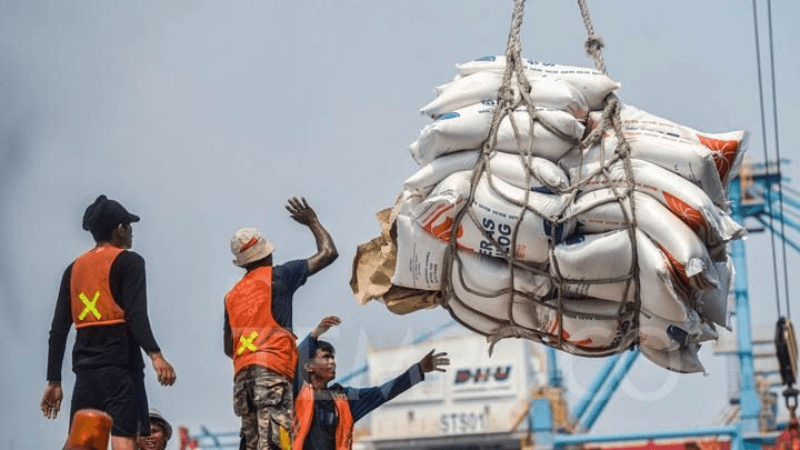
To fortify its rice reserves, the Indonesian government has raised this year's rice import quota by 1.6 million tonnes, according to an announcement by the National Food Agency (Bapanas) on Monday. The decision, driven by concerns over potential shortages during the upcoming Ramadan holiday season, aligns with President Joko “Jokowi” Widodo's vision of maintaining a robust reserve, ideally reaching 3 million tonnes. While the official minimum requirement is 1.2 million tonnes, the additional allocation serves as a precautionary measure to address potential fluctuations in rice supply and demand.
Out of the initially allocated 2 million tonnes for this year, approximately 500,000 tonnes have already been imported, with the remaining 2 million tonnes expected to arrive soon, managed by the State Logistics Agency (Bulog). This decision comes as the price of rice exceeds Rp 16,000 (US$1.02) per kilogram, well above the government's retail price ceiling of Rp 10,900 per kg. Arief Prasetyo Adi, head of Bapanas, emphasized the government's readiness to respond to price fluctuations, highlighting the current imbalance between consumer and producer prices.
The government has tasked Bulog with selling rice below the price ceiling through the food supply and price stabilization (SPHP) program, which has already distributed 250,000 tonnes of rice this year. Additionally, Bulog, responsible for managing and distributing food stocks, is engaged in the cheap food movement (GPM), selling rice directly to consumers in 5-kilogram packages at prices below the highest retail price. To ensure wider availability, rice millers are urged to distribute rice in 5-kilogram sacks rather than in bulk.
Despite being a major rice producer, Indonesia faces challenges such as weather patterns and crop yield fluctuations. In 2022, the country imported 500,000 tonnes of rice from countries including Thailand, Vietnam, India, and Pakistan. A recent memorandum of understanding with India allows for an additional import of 1 million tonnes. The current increase in the import quota by 1.6 million tonnes further strengthens Indonesia's position in managing potential shortages and price volatility, showcasing the nation's commitment to food security. The proactive approach in increasing the rice import quota shows the government's dedication to ensuring a stable rice supply. The upcoming Ramadan holiday season will serve as a litmus test for the effectiveness of these measures.
BOB Post