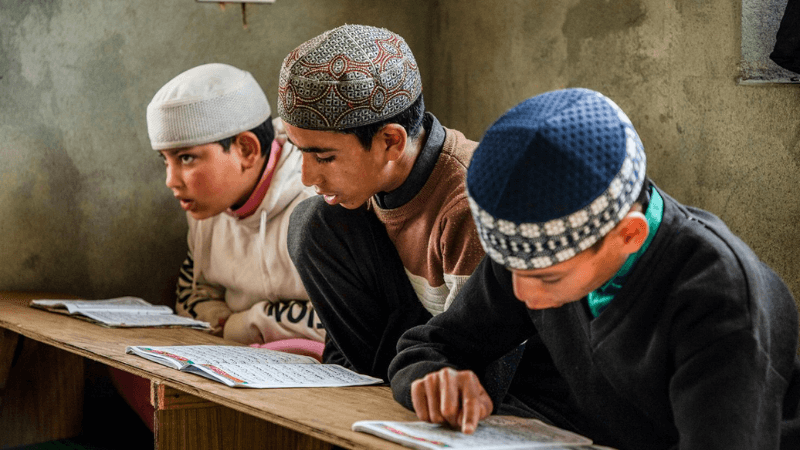
Just weeks before a national election that might widen religious divides in the nation, a court in the most populous state in India essentially banned Islamic schools by declaring the madrasa regulation legislation unconstitutional. According to CNN, the Allahabad High Court in Uttar Pradesh ruled that the Madrasa Act of 2004 was unconstitutional and ordered the state government to move children from Islamic schools to regular educational establishments.
An essential component of the Indian Constitution, secularism, is violated, according to the high court's ruling on the Madrasa Act of 2004. The court held that as the State has primary responsibility for education, it must uphold secularism in the exercise of its power. The State is not allowed to create distinct educational systems for multiple religions or to support the propagation of a particular religion, its doctrines, or its teachings.
Madrasas offer an educational framework where students study the Quran and Islamic history alongside traditional subjects like math and science. Similarly, Hindus may enroll their children in Gurukuls, residential institutions where students learn about ancient Vedic scriptures alongside general subjects under the guidance of a "guru" or teacher. The ruling is subject to appeal in the Supreme Court of India.
Uttar Pradesh, with a population of around 200 million, has a significant Muslim minority of approximately 20%. Governed by Prime Minister Narendra Modi's Hindu nationalist Bharatiya Janata Party (BJP), the state has enacted controversial laws seen as discriminatory against Muslims. A recent court order striking down a law governing madrasas affects 2.7 million students and 10,000 teachers. This decision comes just ahead of a nationwide election, anticipated to involve around 960 million eligible voters, with Modi's BJP expected to retain power. The ruling reflects a growing religious polarization in India.
The Allahabad High Court cited India's constitutional separation of religion and state when ruling against madrasas, but critics frequently accuse Modi of undermining India's secular traditions. Earlier this year, Modi oversaw the inauguration of a controversial Hindu temple built on the site of a demolished mosque, symbolizing a shift away from secularism. Many fear that anti-Muslim sentiment is rising, evidenced by hate speech and demolitions of Muslim-owned properties. While the BJP denies discrimination against Muslims, it has been accused of passing laws, such as in Assam, that target Islamic institutions for conversion into regular schools.
The state's former Education Minister, now Assam's chief minister, Himanta Biswa Sarma, stated that the law aimed to provide equal education opportunities for all children and facilitate access to higher education. However, opposition politicians denounced the move, alleging it reflected a growing anti-Muslim sentiment in the Hindu-majority nation. Senior opposition leader Debabrata Saikia claimed the BJP passed the law to secure more Hindu votes.
BOB Post