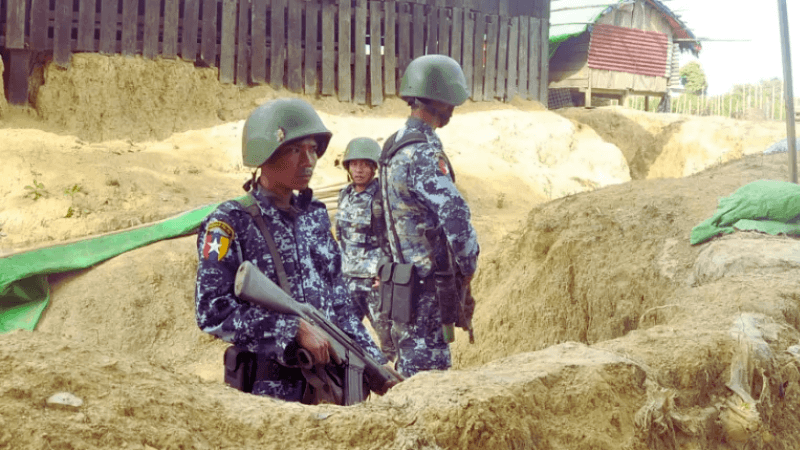
In response to repeated defeats across Myanmar, the military regime enforced the Conscription Law last week, allowing the military to summon all men aged 18-35 and women aged 18-27 for compulsory military service lasting two to five years. There is an extended age limit of 45 for men and 35 for women with professional skills such as doctors and engineers. The junta has already recalled retired soldiers, jailed troops, and pro-military militias to bolster its ranks.
Interviews were conducted with representatives of revolutionary groups, military analysts, and lawyers to gauge reactions to the junta's Conscription Law. Khun Bedu, president of the Karenni Nationalities Defense Force, highlighted the public's disapproval, emphasizing that the law is forced upon the people who do not accept the regime as their legitimate government. He expressed doubt about the military's ability to find recruits willing to protect the regime, foreseeing disharmony between old soldiers and new recruits.
Padoh Saw Taw Nee, spokesman for the Karen National Union, pointed out that Junta leader Min Aung Hlaing enforced the law due to a lack of alternatives, acknowledging that every law enacted by an illegitimate regime is inherently illegal.
Salai Htet Ni, spokesman for the Chin National Front, emphasized that the regime is losing, facing heavy losses and violating the 2008 Constitution.
U Kyaw Zaw, National Unity Government spokesman, stressed the law's lack of legitimacy, labeling the regime as a terrorist organization without the mandate to enact laws.
Dr. Mie Mie Winn Byrd, a Burmese professor at Hawaii’s Asia Pacific Center for Security Studies, deemed the law illegal, highlighting the junta's dictatorial actions.
U Kyi Myint, a political activist lawyer, emphasized Min Aung Hlaing's lack of mandate and the law's reflection of the junta boss's weakness.
Ex-army captain Lin Htet Aung, part of the nationwide civil disobedience movement, expressed concerns about the junta using civilians to fill its weak military, potentially causing harm and forcing people to fight against each other or anti-regime revolutionary groups.
The junta's desperation is evident as it faces heavy shortages of combat soldiers, resorting to conscription to address its weakening position. The impact of this controversial move on Myanmar's future remains uncertain, but it further emphasizes the junta's vulnerability in the face of widespread opposition.
BOB Post