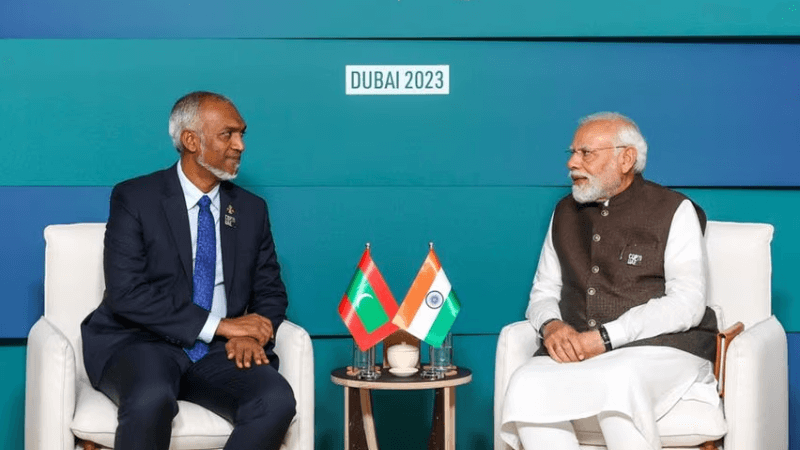
The Maldivian president, upon his return from China where he sealed a series of deals, urged India on Sunday to withdraw its nearly 100 troops by March 15. New Delhi, considering the Indian Ocean archipelago within its sphere of influence, faces a shift in the Maldives towards China, its largest external creditor.
The March deadline was established during talks between Indian officials and the Maldivian president on Sunday, as confirmed by President Mohamed Muizzu's top aide, honoring a long-standing election pledge. Abdulla Nazim Ibrahim, Muizzu's Public Policy Secretary, informed reporters, "The president put forth this request at the meeting of the high-level committee between the two nations... the proposal is currently under consideration."
India presently deploys around 89 personnel, including medical staff, to operate three aircraft for patrolling the vast maritime territory of the archipelago. On Sunday, New Delhi's foreign ministry stated that diplomats discussed finding a "mutually workable solution" for continued Indian air operations, emphasizing their humanitarian and medical evacuation services. A subsequent round of talks is expected, although no date has been specified.
Muizzu, who assumed power in September with a promise to evict Indian forces, asserted on Saturday in the capital Male that, despite being small, the Maldives would not tolerate bullying. "We are not a country that is in the backyard of another country. We are an independent nation," Muizzu declared. He emphasized that China respects the territorial integrity policy, particularly in the nation's Dhivehi language.
In the context of Beijing and New Delhi competing for influence, Muizzu, elected in September, vowed to cultivate "strong ties" with China. Denying any intention to alter the regional balance by replacing Indian troops with Chinese forces, he made his first state visit to China this week. CCTV reported that the deals with China covered infrastructure, medical care, healthcare, livelihood improvement, new energy sources, agriculture, and marine environmental protection.
Tensions with New Delhi escalated when three of Muizzu's junior ministers reportedly called Indian Prime Minister Narendra Modi a "clown" and a "terrorist" in since-deleted social media posts. This led to calls from Bollywood actors and Indian cricket figures to boycott the Maldives, impacting the tourism sector that constitutes nearly a third of the country's economy.
Muizzu also announced plans to reduce reliance on India for healthcare and medicine. The Maldives will diversify options for government-paid health treatment abroad, moving beyond India to include the United Arab Emirates. Importantly, Muizzu revealed intentions to source pharmaceuticals from the United States and European nations, reducing dependence on Indian imports.
Simultaneously, Muizzu, the former mayor of the capital, faced his first electoral setback as his party's candidate lost the vote to replace him. Adam Azim of the Maldivian Democratic Party, perceived as more pro-Indian, emerged victorious.
BOB Post