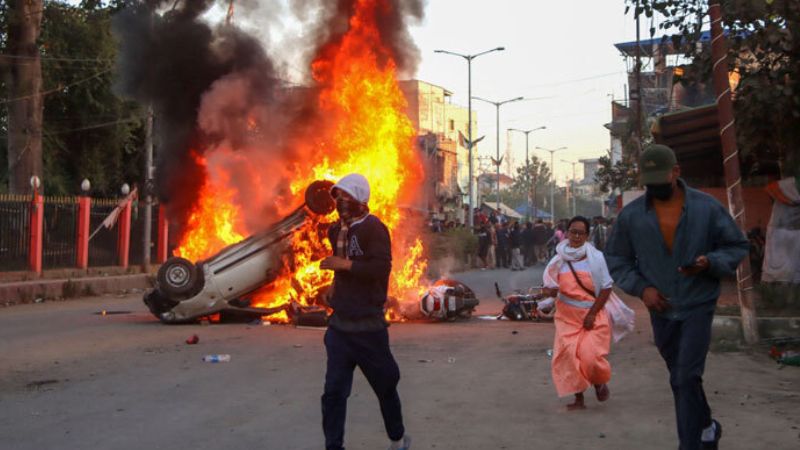
The situation in Manipur has spiraled out of control, exposing a glaring failure of the Indian government to restore peace and stability in the state. The violence, which reignited recently, has seen the homes of three state ministers and six MLAs (Member of Legislative Assembly) set on fire by enraged mobs. Authorities impose an indefinite curfew and cut off internet services in several districts. The unrest, far from being contained, now threatens to spill over into neighboring states, posing a grave risk to the unity and sovereignty of India.
The Congress Party leader, Mallikarjun Kharge, has openly criticized Prime Minister Narendra Modi for neglecting the crisis, accusing him of being more concerned with maintaining his political power than addressing the escalating violence in Manipur. Kharge’s statements on social media highlight a growing sentiment that the central government is deliberately allowing the state to burn, driven by a political agenda that thrives on division and conflict.
Since May 2023, Manipur has been engulfed in severe ethnic violence, which has left hundreds dead and displaced tens of thousands. Despite months of unrest, the government's response has been ineffective, with no concrete steps taken to bring conflicting communities to the negotiation table. The recent killing of six people, followed by the discovery of three bodies in a river, has intensified the anger among the people, sparking protests that have turned violent. The attacks on the residences of state leaders, including the home of Chief Minister N Biren Singh's son-in-law, are a clear indication of the public’s frustration and the deep-seated grievances that remain unaddressed.
The failure to restore law and order has also emboldened Naga rebel groups, who have issued threats against the government, further complicating the situation. The Naga rebels, who have been engaged in a long-standing conflict with the Indian state, have warned of renewed insurgency if their demands are not met. This is a dangerous development, as the involvement of rebel factions could escalate the violence beyond Manipur, spreading to other parts of the northeastern region, which has a history of ethnic and separatist conflicts.
Rahul Gandhi, a prominent opposition leader, has also voiced his concern, labeling the ongoing crisis as a threat to India’s unity. He criticized Prime Minister Modi’s lack of engagement, pointing out that while the people of Manipur suffer, the Prime Minister has been busy with international tours, ignoring the urgent need for peace and reconciliation at home. Gandhi urged the central government to take immediate action, warning that the situation could worsen if left unchecked.
The recent escalation of violence is not just a local issue; it is becoming a national crisis with potential ramifications for India’s sovereignty. The fear of ethnic violence spilling into neighboring states like Nagaland, Mizoram, and Assam is real. These regions have their own complex ethnic dynamics, and any spread of conflict could destabilize the entire northeastern corridor, threatening the dream of a united and undivided India.
In this volatile situation, the central government's apparent inaction is seen as a grave failure. The prolonged crisis in Manipur is a stark reminder of the urgent need for a coherent strategy to bring lasting peace to the region. The political divide and ethnic tensions have been left unaddressed for far too long, and now the consequences are threatening to undermine the fabric of the nation itself.
BOB Post