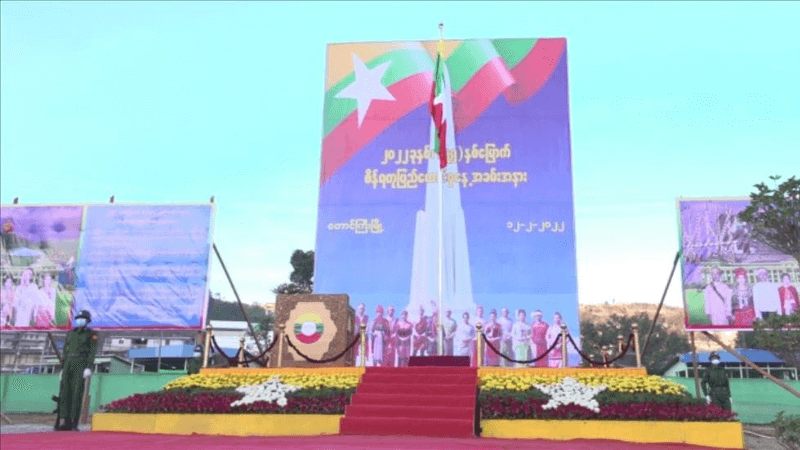
Myanmar observed the 77th anniversary of Union Day with a state ceremony in the capital, Nay Pyi Taw, on Monday (12 February) morning.
The historic occasion, which took place on February 12, 1947, commemorates the signing of the Panglong Agreement by General Aung San and over 20 ethnic leaders, signaling their collective effort to regain independence from British colonial rule.
In his Union Day message, Chairman of the State Administration Council Senior General Min Aung Hlaing emphasized the importance of protecting independence and sovereignty through the unity of all ethnic groups. He urged the people to uphold the spirit of unity for the long-term preservation of the country.
The ceremony in Nay Pyi Taw was attended by over 1,000 representatives from the government and various ethnic groups. The event featured a parade with armed forces' guards of honor. Additionally, activities such as an expo showcasing small and medium-sized enterprises products and horse-racing competitions were organized to commemorate Union Day in Myanmar.
Union Day marks the 1947 Panglong Conference, a crucial gathering that brought together Myanmar's diverse multi-ethnic population to form a cohesive and eventually sovereign nation in the months leading up to the country's independence from British rule.
Formerly under British administration from 1886, Myanmar underwent a distinctive governance approach for central Burma compared to various ethnic groups in the surrounding areas. General Aung San convened the Panglong Conference after World War II, uniting leaders from the Shan states, Kachin hills, and Chin hills. The resulting Panglong Agreement, signed on February 12, 1947, paved the way for Burma's independence in January 1948, granting freedom from British administration.
Although Aung San did not live to witness Burma's independence, his legacy endured until a military coup in 1962 led to almost half a century of army dictatorship. In 1989, the military government renamed Burma as Myanmar.
BOB Post