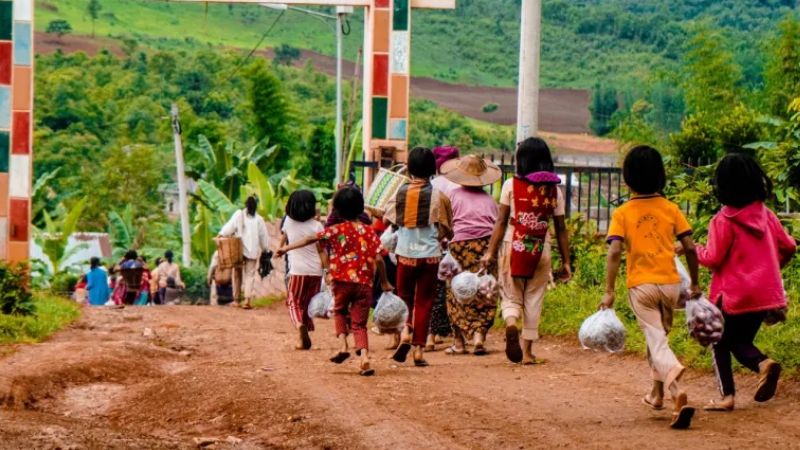
The United Nations reported on Friday that more than 3.5 million people have been displaced by armed conflict in Myanmar, marking an alarming increase of 1.5 million from last year. The organization warned that the country’s humanitarian crisis is on the brink of further deterioration.
Since the military coup in 2021, Myanmar has been engulfed in fierce fighting between ethnic rebel groups and the army. These groups, which have sought autonomy and control over lucrative resources since Myanmar’s independence, have seen their battles with the military escalate beyond borderlands to almost every region of the country.
The UN Office for the Coordination of Humanitarian Affairs (OCHA) highlighted the scale of the crisis in a statement, noting that the violence has "forced record numbers of people to flee their homes in search of safety and meeting their basic needs."
As of December 16, OCHA estimated that “over 3.5 million people — more than six percent of the total population of 57 million — across Myanmar are now displaced, approximately one-third of them children.” The agency called this a “staggering increase” of nearly 1.5 million internally displaced persons compared to the previous year.
OCHA described the closing days of 2024 as being marked by "intense fighting involving air strikes, drone attacks, artillery shelling, raids, and arbitrary arrests."
The agency painted a bleak picture for the year ahead, warning that “an unprecedented humanitarian crisis fueled by escalating conflict, disasters, epidemics, widespread explosive ordnance and landmine contamination, and economic collapse” is on the horizon.
"If these trends persist, the humanitarian situation will deteriorate further, leaving millions of people in urgent need of assistance," OCHA cautioned.
The UN has projected that 19.9 million people in Myanmar—more than a third of the population—will require humanitarian aid in 2025. To address this, OCHA has launched an appeal for $1.1 billion in funding to provide "life-saving assistance" to 5.5 million people. However, the agency acknowledged that such appeals are "chronically underfunded," casting doubt on the ability to meet the growing needs.
BOB Post