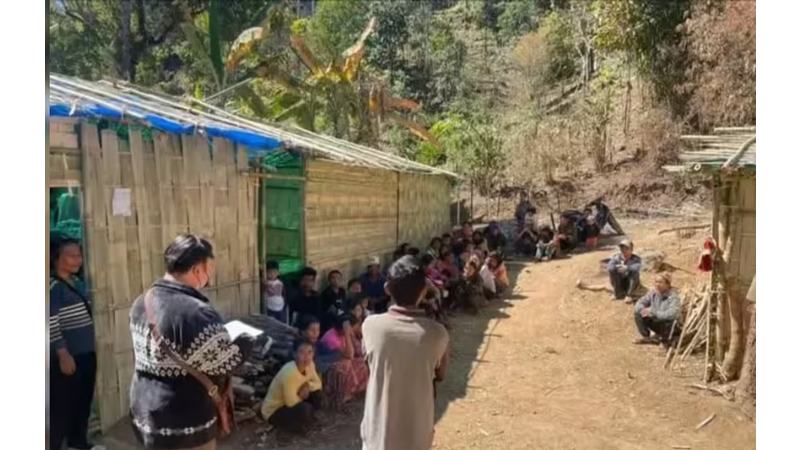
More than 3,000 people from Myanmar's Chin State have crossed into India over the past four days, seeking refuge in Mizoram following fierce clashes between two anti-junta ethnic militias, Indian officials confirmed on Sunday.
The latest influx has raised the number of Myanmar nationals sheltering in Mizoram to over 35,000, deepening an already complex humanitarian crisis in India's northeastern frontier.
According to a senior official who spoke on condition of anonymity, the refugees began arriving in the Zokhawthar area of Champhai district from July 3 onwards. The majority of them came from three villages in Chin State, fleeing a violent armed conflict between the Chin National Defence Force (CNDF) and the Chinland Defence Force (CDF), which raged from June 28 to July 5.

Though both factions represent the same Zo ethnic community and oppose Myanmar’s military junta, they are reportedly vying for control over strategic areas, including Khawmawi, a key commercial and transit town along the Indo-Myanmar border.
"The situation has calmed since Saturday evening after the firing stopped," said the official. "However, the Indo-Myanmar border remains sealed by the Assam Rifles to prevent further escalation, although refugees are still being allowed humanitarian access."
Zokhawthar, a small border town, lies directly opposite Khawmawi, separated only by the Tiau River. The latest arrivals included another 300 people on Sunday alone.
Amid the unrest, the Central Young Mizo Association (CYMA)—Mizoram’s largest and most influential civil society body—has intervened to mediate between the warring factions. CYMA General Secretary Malsawmliana stated that both CNDF and CDF have agreed to a ceasefire and to pursue a peaceful resolution to their dispute.
This is not the first time Mizoram has seen an influx of refugees from Myanmar since the military coup in February 2021. The state shares deep ethnic and cultural ties with the Chin people, and the local government has generally adopted a humanitarian approach, despite the central government's tougher stance on border security and refugee inflows.
However, the recent fighting between two anti-junta forces—once seen as allies—has raised concerns about fragmentation within Myanmar’s resistance movement. The lack of unified command and increasing territorial rivalries could undermine the broader democratic struggle against the junta.
Observers warn that such intra-ethnic strife not only complicates the situation on the ground in Myanmar but also creates new challenges for border communities in India that are already under strain.
While Mizoram's compassion and civil society activism continue to draw praise, the Indian central government’s silence on providing structured support or refugee policy reform remains glaring. The humanitarian response is largely community-driven, with minimal federal coordination or resources.
As cross-border conflict intensifies, India must move beyond border sealing and ad-hoc refugee admissions to develop a long-term strategy. This includes engaging with civil society, strengthening local relief mechanisms, and advocating for regional peace efforts to address the root causes of displacement in Myanmar.
BOB Post