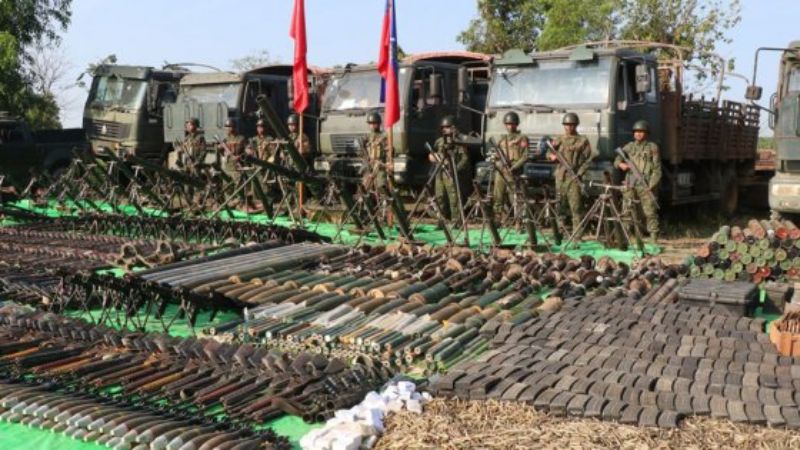
The military in Myanmar is still able to obtain money and weapons for its battle against anti-coup groups, despite efforts to isolate the country's governing junta hindering its capacity to do so, a UN expert said on Wednesday.
Financial sanctions against the military, banks, and related companies were the response from the West. After three years, what began as a protest movement has escalated into a full-fledged civil war, with the junta being accused of using airstrikes to target both civilians and rebels as it begins to lose control over large areas of territory.
UN Special Rapporteur on the situation of human rights in Myanmar, Tom Andrews, revealed in his report that the junta imported $253 million worth of weapons, dual-use technologies, manufacturing equipment, and other materials in the year up to March 2024. This figure is a third less than the previous year, thanks largely to Singapore's efforts to prevent its companies from aiding the junta.
Reducing the military's capacity to restock is one way that international efforts and sanctions are having an effect, according to Andrews in a Reuters interview. Thus, the military's ability to launch strikes similar to the airstrikes that have killed civilians in their communities is hampered.
“The very means by which they are attacking these villages are dependent upon their access to weapons and materials supplied from overseas,” Andrews said.
Myanmar’s military denies committing atrocities against civilians, claiming it is fighting “terrorists.” Officials have downplayed the impact of sanctions, suggesting they only delay the military’s plans to restore democracy.
The report noted that between 2022 and 2024, entities controlled by the junta’s defense ministry procured $630 million in military supplies. Exports from Singapore fell from over $110 million in the 2022 fiscal year to just above $10 million, indicating significant progress. However, Myanmar’s neighbor Thailand has partially filled this gap. Thai-registered companies transferred $120 million worth of weapons and related materials in the 2023 fiscal year, double the previous year's $60 million.
A notable example in the report highlighted that in 2023, Thailand-registered companies became the junta's source for spare parts for Mi-17 and Mi-35 helicopters, which were previously supplied by Singapore-registered companies. These helicopters are used for transporting soldiers and conducting airstrikes on civilian targets, such as the April 2023 attack on Pazigyi village in Sagaing Region that killed approximately 170 people, including 40 children.
Thai Prime Minister Srettha Thavisin told Reuters in April that Thailand will remain neutral and address all concerns regarding the conflict. The Myanmar military claimed that members of the armed resistance were killed in the Pazigyi village strike.
BOB Post