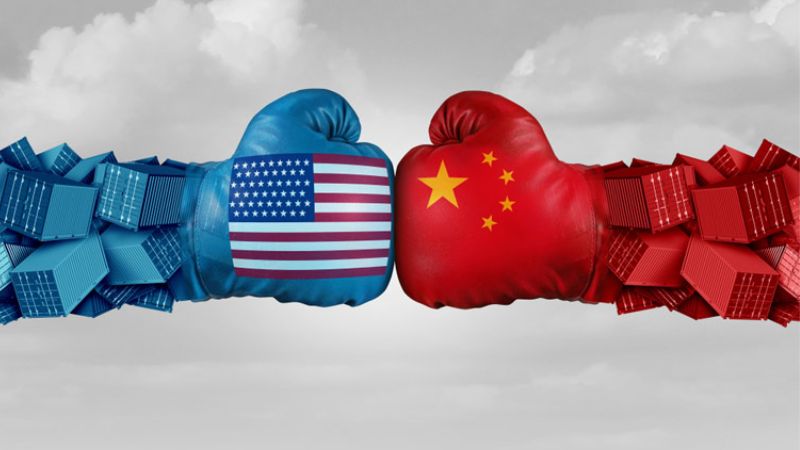
In the midst of Myanmar's ongoing civil conflict, the escalating rivalry between the United States and China in Southeast Asia poses significant challenges for the country. Despite internal instability, Myanmar's role in the broader U.S.-China competition cannot be overlooked. Vulnerable to Chinese influence, Myanmar faces the risk of becoming economically dependent on China rather than prioritizing its own interests. Understanding how China and the U.S. perceive Myanmar's conflict is crucial for resistance leaders seeking to restore civilian governance and ensure a democratic and stable future.
China's substantial economic investments in Myanmar aim to increase its sphere of influence in the region, potentially turning Myanmar into a "pseudo-Chinese state" and providing Beijing with strategic advantages, especially in accessing the Indian Ocean. In exchange for economic benefits and access to natural resources, China has historically shielded Myanmar's military regimes from international condemnation at the UN Security Council. In contrast, the US has a history of supporting democratic forces in Myanmar, welcoming reforms and lifting economic sanctions when the country transitioned to quasi-civilian and democratic governance. The US and its allies are concerned about China's growing influence in Myanmar and its implications for regional stability.
Before the 2021 coup, Myanmar's NLD government sought to balance China's influence by inviting investments from other countries while setting development criteria to safeguard national interests, allowing civil society to voice concerns over Chinese projects. However, since the coup, Myanmar has regressed drastically, with the junta leading the country toward a failed state marked by human rights violations and escalating violence. Opposition forces have intensified fighting against the junta, which has suffered significant losses. Without democratic restoration, Myanmar remains vulnerable to foreign influence. Yet, coordinated efforts among revolutionary forces could potentially restore stability and leverage U.S.-China competition to serve Myanmar's interests.
Following the coup in Myanmar, the U.S. government has resumed sanctions against the military junta and supports resistance forces, while not officially endorsing the National Unity Government (NUG) as Myanmar's legitimate government. China initially kept its distance from the junta to avoid backlash, but eventually resumed diplomatic cooperation. Despite tensions, China continued with the CMEC project with the junta's support, leading to negative impacts on local communities. China also engaged with ethnic armed groups to prevent instability and address cybercrime threats along the border. In response to the U.S. Burma Act, China increased support for these groups to counter potential U.S. influence. Concerns over national security intensified after Chinese nationals were killed in a junta-backed cybercrime operation. Despite efforts, the junta has not addressed these criminal activities, leading to further involvement from China.
Operation 1027, launched by ethnic armed groups in northern Shan State, seemingly with China's endorsement, aimed to combat the military junta and online gambling fraud. The junta suffered significant territorial losses, bolstering revolutionary forces elsewhere. The opposition's coordination suggests a readiness to exploit China's security concerns and impatience with the junta. Despite brokering a cease-fire, China's control over the warring parties proved limited, as the junta violated the agreement shortly after. Uncertainty looms over China's economic interests in the region and its potential to influence the revolutionary agenda of the Northern Alliance.
Moving forward, Myanmar's resistance faces a landscape where China's influence is likely to expand, as both the military and the National Unity Government (NUG) leverage it for their agendas. Despite initial anti-China sentiments following Operation 1027, the junta relies on China for international protection and has reaffirmed its allegiance, while the NUG aligns with China's support. Amid long-standing suffering under military rule, the Myanmar people seek a federal democracy and would accept Chinese support for their revolutionary efforts, despite its alignment with China's interests. However, caution is necessary against both the military's divisive actions and China's expectations of reciprocity. Instead of settling for short-term Chinese support, resistance forces must prioritize internal unity towards the overarching goal of a federal democratic state with good governance, safeguarding national interests while leveraging Chinese support wisely.
In furthering this ultimate goal, resistance leaders can also take advantage of U.S.-China competition. The Unted States would not want to see Myanmar subjected to the absolute influence of China. And playing each country’s national interests off one another — as the NLD government did in the pre-coup era — could help a small state like Myanmar level the playing field and assert its own ambitions in a more conducive strategic environment.
Additionally, one of the issues holding Myanmar back from better navigating U.S.-China competition is the fractured nature of governance. The junta regime remains heavily sanctioned by the United States. And while there is ample international support for the NUG, its ability to govern — yet alone conduct foreign policy — is deeply hampered by its lack of official recognition. One intermediate goal for resistance leaders could be securing U.S., and perhaps even Chinese, recognition of the NUG as a legitimate government.
Myanmar’s pro-democracy resistance is right to seize any support in their fight against the junta. But to ensure that a return to civilian rule is accompanied by good governance and stability, resistance actors will need to possess the ability to ward off foreign interests that come at the expense of Myanmar’s citizens. This will be no small feat in the face of U.S.-China rivalry. To succeed will require political dialogue among various ethnic groups and resistance forces, as well as a commitment to play the interests of the two major powers against one another.
BOB Post