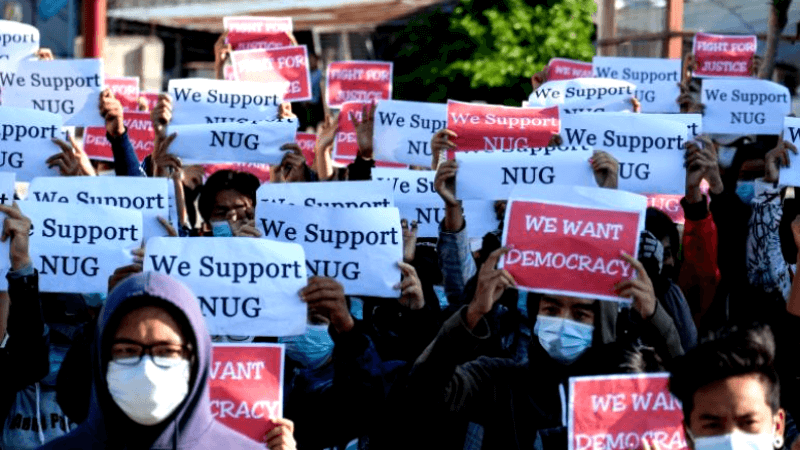
A recent survey conducted by the authors reveals that Myanmar's alliance of ethnic armed groups, engaged in a three-month offensive against the military regime, has significantly weakened the junta. The data, based on responses from 4,612 Burmese adults across various ethnicities, demonstrates widespread support for the National Unity Government (NUG), comprising elected representatives from the 2020 election and ethnic minority leaders. This support spans diverse ethnic groups, suggesting a potential basis for stability in the country.

The survey unveils robust and widespread support for the NUG, with nearly 92% of respondents, including both Bamars and ethnic minorities, expressing a favorable view. This substantial backing translates into concrete actions, as supporters are more likely to contribute financially to resistance and humanitarian efforts. Notably, the survey challenges preconceptions about ethnic identity being a divisive force, revealing a positive correlation between strong attachment to ethnic identity and a unified Myanmar identity.
Crucially, the NUG's support extends beyond its formal alliances, garnering high backing even from ethnic communities whose armed organizations are not aligned with it. The Rakhine community, traditionally aligned with the Arakan Army, provides a noteworthy endorsement, emphasizing a unified front within the pro-democracy movement. However, a notable concern highlighted is the perceived Bamar dominance within the NUG, particularly among ethnic minorities. Urgent measures are necessary to address this perception, build trust, and accommodate the interests of diverse communities to ensure stability.
The survey indicates the imperative for political dialogues and cooperation between the NUG and ethnic armed groups. As resistance forces achieve military gains, there is an escalating urgency for an agreement on a postwar political arrangement, crucial for Myanmar's future stability. The strong public support revealed by the survey presents an opportune moment for the country to progress towards stability and lasting peace. To capitalize on this, decisive actions and inclusive political engagements by the NUG and ethnic armed organizations are deemed crucial, marking a pivotal juncture in Myanmar's political landscape nearly three years after the coup.
BOB Post