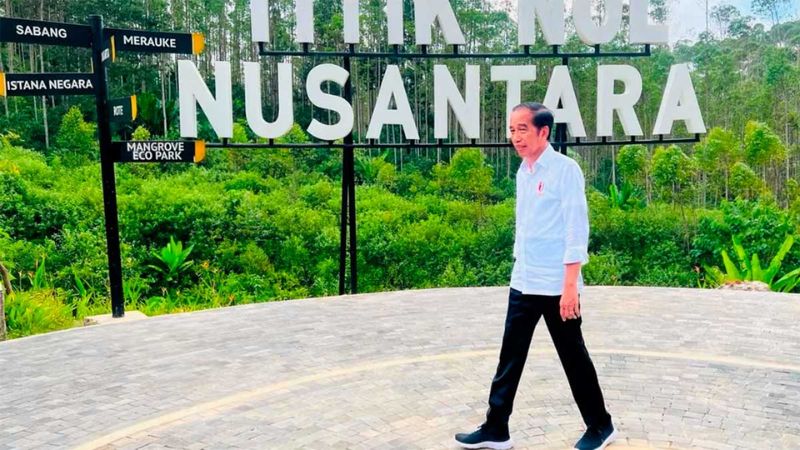
In the heart of eastern Borneo, a colossal undertaking is shaping the contours of Nusantara, Indonesia's forthcoming administrative capital. Spanning a vast expanse of 2,560 square kilometers, this ambitious project intertwines industrial estates, mining ventures, Indigenous communities, and agricultural landscapes.
It was decided to move the capital from Jakarta to this expanding location because to Jakarta's rapid decline into the sea, which was caused by over-extraction of groundwater and unchecked development. A portion of Jakarta is sinking 11 centimeters a year; this is exacerbated by the growing climate emergency, which foretells high tides, stormy skies, and rising sea levels. As much as 25% of Jakarta's land might be submerged by flooding by the dire predictions of 2050, which is why Indonesia is taking the initiative to carry out this bold relocation project in response to the pressing problems of urban aging and environmental deterioration.
Nusantara's strategic placement within the precincts of East Kalimantan epitomizes Indonesia's aspirations to diffuse power and prosperity across its sprawling archipelago, boasting 17,000 islands. This maneuver is envisioned to galvanize investments and fortify infrastructural networks in the vicinity, a prospect that garners favor from many local denizens. The architects of Nusantara envisage a modern, sustainable arboreal city, pledged to harmonize with nature, and attain carbon neutrality by 2045.
However, doubts surround the validity of this capital relocation plan in reducing Jakarta's sinking and distributing money fairly. Some doubt if this project, supported by President Joko Widodo, is mostly a ruse to leave a spectacular legacy. Even with promises of a groundbreaking urban landscape, concerns remain over the project's enormous scope, rushed execution, and perhaps excessive costs. In addition, worries exist about its effects on the environment and potential negative consequences on Indigenous communities. With the construction of the presidential palace, which is modeled like the legendary Garuda bird, approaching its August inauguration, the conversation around Nusantara's development is getting more and more heated.
The construction of Nusantara began in July 2022, and projections indicate that by 2045, the population will have increased to 1.9 million, more than double that of Balikpapan, the closest city. The industrial revolution has already resulted in deforestation and altered landscapes, making problems like flooding worse. Modern infrastructure projects such as dams have upended long-standing traditions and sacred grounds, and the lack of land ownership records leaves many villages vulnerable to forced relocation without a legal defense.
Yati Dalia, a 33-year-old descendant of the Balik Indigenous community, was forced to leave her home and her family's land in November due to Nusantara's continuous growth. She is separated from and uprooted from her ancestral moorings, and the promised compensation of 150 million rupiah is yet unfulfilled.
Deputy of Nusantara's administrative body Myrna Asnawati Safitri acknowledges the complex nature of land disputes and says that protocols recognizing locations significant to indigenous populations historically are nearing approval. But the project's insatiable thirst for energy, water, and infrastructure goes far beyond the city's center, infiltrating surrounding areas and ecosystems, pointing out concerns about the preservation of vital natural habitats and species that are in danger of going extinct in what is referred to as the “lungs of the world.”
Lamale, a devoted supporter of the restoration of mangrove habitats near his Mentawir home, faces the threat of more damage as a result of the Nusantara project. Even though his area has been saved from destruction and designated for eco-tourism, a section of mangroves has already been destroyed to make way for electricity lines, and plans for a toll road are clearly visible. Worries are raised since 1,700 hectares of mangroves have already been destroyed, putting the 12,000 hectares around Balikpapan Bay in jeopardy.
A local environmental overseer named Mappaselle warns of dire consequences that include increased sedimentation and the extinction of fish, coral reefs, and dugongs. This environmental degradation jeopardizes the survival of fishing communities dependent on these habitats, potentially forcing them out of the area.
Even as Nusantara authorities affirm their commitment to safeguarding mangroves within the city's precincts, concerns linger concerning those beyond, where enforcement remains a herculean task. The destiny of the critically imperiled Irrawaddy dolphins, imperiled by augmented vessel traffic stemming from the project, hangs in the balance.
There exists trepidation that, in the quest for private investments, crucial to underwriting 80% of the developmental outlay, environmental benchmarks might be compromised. Environmental advocacy groups have long bemoaned the paucity of oversight over enterprises operating in the area, flagging the perils to biodiversity and ecosystems.
Professor Sulfikar Amir of Nanyang Technological University in Singapore, a former spokesperson for opposition presidential candidate Anies Baswedan, questions potential investors' attraction to the Nusantara project. He brings up the sobering example of Johor, Malaysia's Forest City, which is virtually abandoned despite Chinese support..
The slow pace of foreign investment inflows, regardless of President Joko Widodo's claims of significant investor interest as of November of last year, reinforces this mistrust. The project's potential to attract substantial foreign investment is still questionable due to concerns about its economic feasibility and the track record of similar projects in the past.
BOB Post