Last month, as Bangladesh faced political uncertainty following the fall of Sheikh Hasina's government, Nobel Peace Prize recipient Muhammad Yunus returned to the country to guide it through turbulent times.
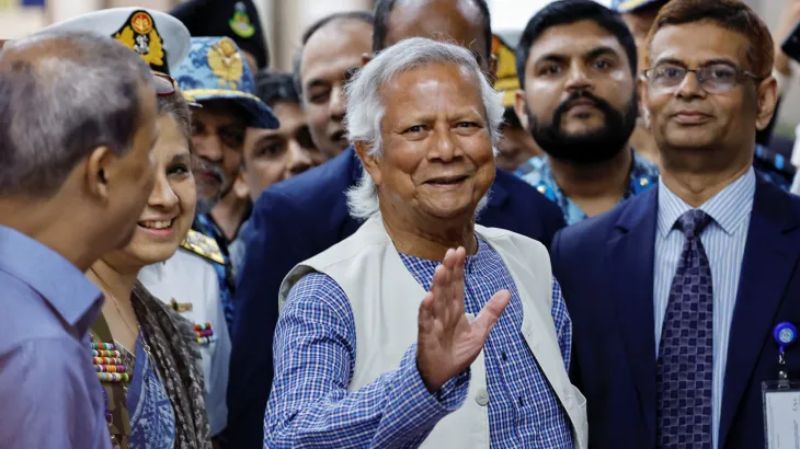
Yunus, once targeted by legal threats under Hasina's leadership, has now emerged as a key figure in restoring stability. Many anticipated his arrest during Hasina’s tenure, but on August 8, he returned from Paris to a warm welcome, swiftly assuming a leadership role in a country in transition. His longtime adversary, Sheikh Hasina, fled the country three days earlier.
The student-led protests, which played a significant role in sparking a nationwide uprising, endorsed Yunus as the head of an interim government. His acceptance of the role was met with widespread relief and optimism as the esteemed economist became a symbol of hope for Bangladesh.
Yunus’ return marked the end of a brief power vacuum. He addressed the nation, calling for unity and hope, referring to the moment as a "second liberation." At Dhaka airport, he spoke emotionally, remembering those lost in the struggle, including Abu Sayed, who was killed during protests. His message of national rebirth resonated strongly with the people, but the real challenges were yet to come.
In the wake of weeks of violent protests, the interim government faced the daunting task of restoring order. While the police force remained demoralized and hesitant to act, the frequency of retaliatory attacks diminished, though concerns over ongoing violence and extortion lingered. Addressing corruption within state institutions, Yunus began a series of reforms, appointing a former IMF economist to oversee the central bank and launching an investigation into the misconduct of the previous government. The economy, while struggling, began showing signs of recovery as Yunus focused on stabilizing the banking sector and attracting foreign investment.
Bangladesh, once hailed for its economic growth post-military rule in 1990, had suffered setbacks due to inflation and currency shortages, exacerbated by recent unrest. Under Hasina’s leadership, corruption and mismanagement had hindered economic reforms, and the garment industry—vital to the nation's economy—was severely impacted by cancelled international orders.
Yunus’ top priority now is restoring the independence of key democratic institutions, starting with the Election Commission, which is crucial for gaining public confidence ahead of upcoming elections. Under Hasina, many institutions, including the judiciary and civil service, had been heavily politicized, while the media and civil society faced strict control.
Rebuilding these institutions will take time, as noted by the International Crisis Group, which emphasized that some will recover quickly while others will bear the scars of political subordination for years.
Yunus faces the complex task of reshaping Bangladesh’s geopolitical relations, particularly with India. Hasina had strong support from New Delhi, but her departure has shifted the dynamics. While the interim government has assured that Bangladesh-India relations will remain stable, growing anti-India sentiment must be carefully managed.
Yunus’ interim administration must also address the grievances of those affected by Hasina’s 15-year rule, while overseeing a peaceful political transition. Engaging in dialogue with political parties, civil society, and international partners, his government aims to restore stability. There is growing support for the revival of the caretaker government system, which was abolished in 2011, as a mechanism to ensure fair elections.
Hasina's exit presents a rare opportunity for Bangladesh to move beyond decades of hyper-partisan politics and to embrace reforms that could lead to a more inclusive and democratic future.
BOB Post