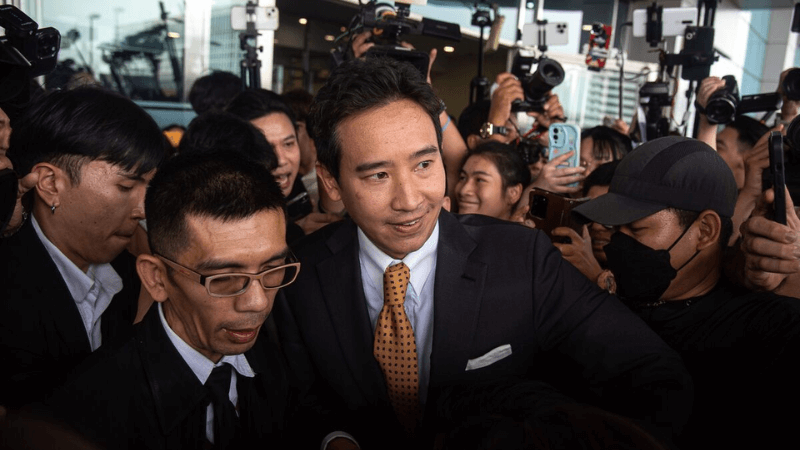
Thailand's Constitutional Court has acquitted Pita Limjaroenrat, leader of the Move Forward Party (MFP), allowing him to make a triumphant return to Parliament after a year-long suspension. The court's unanimous decision dismissed charges of media law violations against Pita, revolving around his social media activities during the 2019 election campaign.
Pita Limjaroenrat had been facing accusations of violating media laws by allegedly using social media platforms to promote the MFP during the 2019 election campaign. These charges had prevented him from assuming his role as the leader of the opposition in Parliament, posing a significant threat to his political career. Following months of legal proceedings, the Constitutional Court ruled in favor of Pita, determining that his social media activities fell within the bounds of fair electioneering and did not breach media laws. This development opens the door for Pita's return to Parliament, injecting newfound vigor into the opposition ranks and introducing fresh uncertainty into Thailand's political landscape.
Pita's acquittal stands as a significant triumph for the Move Forward Party and the broader opposition movement in Thailand. His reinstatement in Parliament is expected to fortify the opposition's voice, providing essential leadership to hold the government accountable. Additionally, the court's decision is seen as a validation of free speech and democratic freedoms in the country.
While Pita's acquittal is undoubtedly a positive development, it does not guarantee smooth sailing for him or the Move Forward Party. The party still faces multiple legal challenges, including charges against several of its members. The prevailing political climate in Thailand remains tense, with a powerful military-backed government cracking down on dissent. Pita Limjaroenrat's return to Parliament has the potential to reshape the dynamics of Thai politics. Known for his charisma and vocal criticisms of the government, his presence could lead to more intense debates and increased scrutiny of government policies. Alternatively, it might create opportunities for dialogue and compromise, depending on the government's willingness to engage with the opposition.
*In a related development, the Constitutional Court dismissed a separate case against Pita, where the Election Commission sought his disqualification as an MP under Article 101 of the Constitution for holding shares in a media firm. The majority of judges voted in favor of Pita, emphasizing that iTV, the media firm in question, had ceased media operations since 2017.*
BOB Post