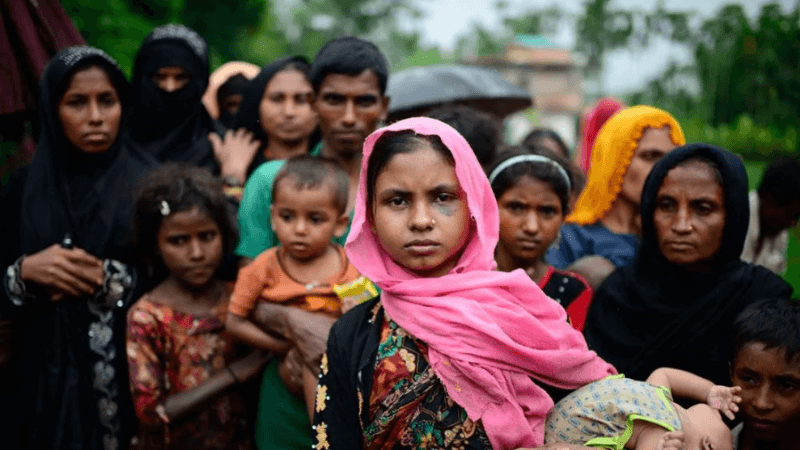
The situation in Myanmar is becoming increasingly complicated. This has a direct impact on Rohingya repatriation. In 2021, the government before the army seized power was persuaded by Bangladesh to repatriate. Later, after the junta took power, communication was stopped for a long time. However, after some visible steps in the repatriation of Rohingyas, the civil war situation in Arakan took a new complicated shape. Experts say that in the current situation there, Bangladesh will have to keep in touch with the armed rebel group Arakan Army to repatriate the Rohingya in the coming days.
The situation in Myanmar is changing rapidly. The rebel groups are occupying one area after another. The junta is losing control in many places. This has added a new dimension to the Rohingya crisis.
The Arakan Army has recently captured an important area near the Bangladesh-India border. However, diplomatic sources in Dhaka and Naypyidaw say that the junta is not at all upset about what the Arakan Army has done or how much land it has occupied. Because, even if the whole of Rakhine is occupied, the Arakan Army will fear losing that area again until the junta admits that it has lost. And if the junta wants to, it can immediately recover the lost areas by naval, air and army.

But the question arises, why the junta is losing these areas. Samakal, a top media outlet in Bangladesh, quoted a diplomat as saying that almost all of the areas occupied by the Arakan Army are jungles and remote areas. Myanmar is not willing to spend more resources and troops in these areas. Many of the army are leaving the service as they have been in the war for a long time.
In this situation, Bangladeshi former foreign secretary and ambassador, Touhid Hossain advised to increase informal communication with the Arakan Army. He said that the ongoing civil war in Rakhine can be resolved in two ways - through conflict or at the negotiating table. As a result, no matter how it is resolved, the region will be dominated by the Arakan Army. So Bangladesh should keep informal contact with them. Because, in the future, Rohingya repatriation will not depend only on the will of the central government.
However, the former top diplomat does not see any possibility of independence of the region. Touhid Hussain said that the National Unity Government (NUG), led by the exiled opposition party of Myanmar, would never want any part of the country to separate. Once the current crisis is resolved, Arakan will have some degree of autonomy. Keeping that aspect in mind, Bangladesh will have to prepare a strategy.
When contacted to inquire about the situation, the Ambassador of Bangladesh in Myanmar, Md. Manowar Hossain said, the situation here is unstable. No information is being provided by the Myanmar government. As a result, whatever information is available, it is coming from the opposition. Nothing can be said for sure right now.
Sources in Dhaka and Naypyidaw said that the Arakan Army is using Rohingyas as human shields. The Rohingyas have been pushed to the front of the war recently when the junta forces launched an operation in Buthidang, Mangdu. In this, anti-junta media reported the casualties of 12 Rohingya.
An official of the Ministry of Foreign Affairs of Bangladesh, on condition of anonymity, said that the Myanmar government is exchanging all types of information except security-related information. Necessary steps for the repatriation of Rohingyas are being taken in stages by Bangladesh. But there needs to be a supportive environment in the beginning. This requires stability. Dhaka is monitoring the situation there.
In Rakhine, insurgents have recently taken over several military checkpoints, border crossings and roads belonging to the junta government. And the rebels are getting support from other armed groups in Myanmar against the junta.
BOB Post