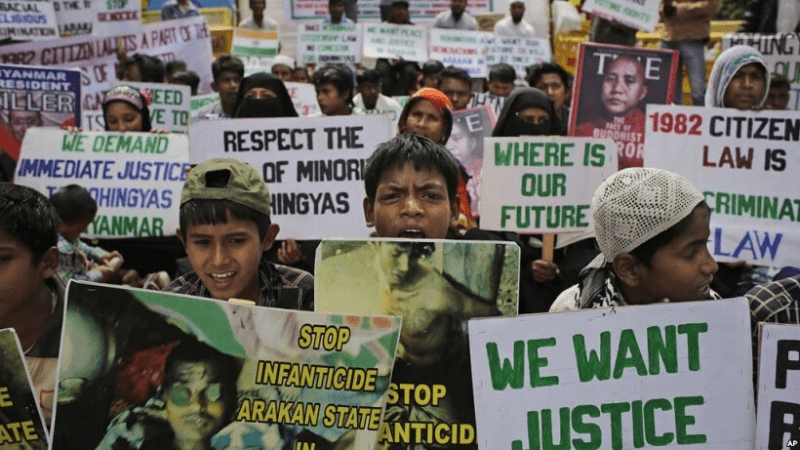
Amnesty International has issued a sharp rebuke of the Indian government over what it described as “cruel and unlawful deportations” of Rohingya refugees, urging an immediate halt to forced returns and calling for full recognition and protection of the persecuted minority under international law.
Ahead of World Refugee Day, the UK-based human rights watchdog reported a disturbing pattern of deportations over the past month, including claims that Indian authorities abandoned at least 40 Rohingya—among them children and the elderly—in international waters near Myanmar, after forcibly removing them from a naval vessel. In a separate incident, over 100 more were expelled across the eastern border into Bangladesh without any legal hearing or asylum process.

“These actions are a blatant betrayal of India’s historical legacy of offering sanctuary to the persecuted,” said Aakar Patel, chair of Amnesty International India. “What message does it send when a nation that once welcomed Zoroastrians, Tibetans, and Sri Lankan Tamils now dumps refugees into dangerous waters or buses them across borders in the dead of night?”
Reports gathered by Amnesty detail harrowing accounts of Rohingya refugees being blindfolded and flown to the Andaman and Nicobar Islands, before being handed life jackets and forced into open sea to reach Myanmar territory. Contact with those individuals has since been lost, heightening fears for their safety.
Despite holding UNHCR-issued refugee identification cards, many Rohingya in India are now living in a state of constant fear. “They come in the night. My friends, my relatives — taken without notice, without explanation,” one refugee told Amnesty on condition of anonymity. “We are not criminals. But the Indian government treats us like we are.”
The Indian government, however, maintains its hardline position, citing the Foreigners Act and its non-signatory status to the 1951 UN Refugee Convention as justification for deportations. In a recent Supreme Court case, the government argued it does not recognise Rohingya as refugees, and the court dismissed a petition seeking protection, calling it a “beautifully crafted story” without sufficient evidence.
Amnesty International condemned the Indian judiciary’s stance and reiterated that the principle of non-refoulement—which prohibits returning individuals to countries where they face serious harm—is part of customary international law and binding even on non-signatory states.
“The lack of a domestic refugee protection framework is not a legal shield to evade moral responsibility,” said Patel. “India’s obligations under the International Covenant on Civil and Political Rights remain clear.”
The Rohingya, a stateless Muslim minority from Myanmar’s Rakhine State, have faced genocide-like conditions since the 2017 military crackdown. While many now live in overcrowded camps in Bangladesh under deteriorating humanitarian conditions, those who sought refuge in India now find themselves in limbo—detained, deported, or hiding in fear.
Amnesty has called on India to immediately stop deportations, ratify the 1951 Refugee Convention, and enact national laws aligned with international standards. The organization also demanded independent investigations into recent deportations and a transparent accounting of the treatment of Rohingya detainees.
Prime Minister Narendra Modi has frequently invoked Vasudhaiva Kutumbakam—the ancient Indian ethos of global unity. Amnesty now challenges him to live up to that ideal.
“On World Refugee Day, India must decide what it stands for: compassion or cruelty, protection or persecution,” Patel added.
BOB Post