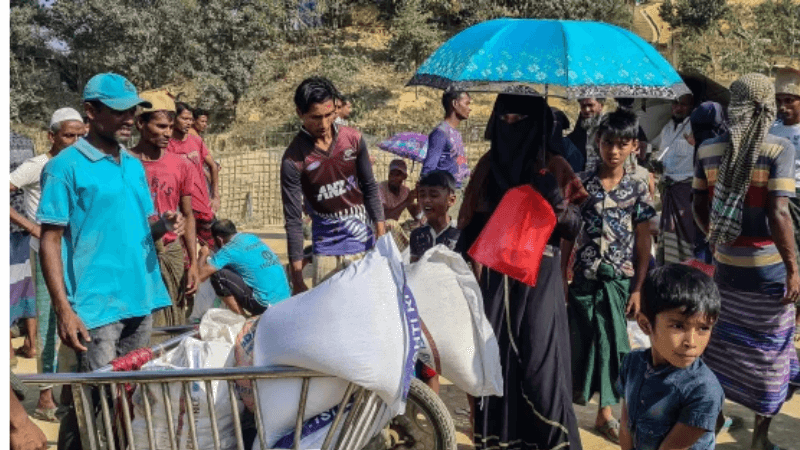
A severe funding shortfall is pushing essential services for over one million Rohingya refugees in Bangladesh to the brink of collapse, the United Nations refugee agency (UNHCR) has warned, raising the alarm on an impending humanitarian disaster.
Bangladesh, which hosts more than 1.3 million Rohingya refugees in 33 congested camps along its southeastern coast, is struggling to manage a worsening situation as international funding dries up. Nearly 150,000 of the refugees arrived over the past 18 months, fleeing renewed violence in Myanmar’s Rakhine State, adding to the influx that began in 2017 when more than 750,000 Rohingya escaped brutal military crackdowns widely labeled by the UN as a “textbook case of ethnic cleansing.”

“With the acute global funding crisis, the critical needs of both newly arrived refugees and those already present will be unmet, and essential services for the whole Rohingya refugee population are at risk of collapsing,” the UNHCR warned in a statement on Friday.
So far, only 35 percent of the agency’s $255 million appeal for the year has been met. The UN says that if additional funds are not secured immediately:
Health services will be severely disrupted by September, jeopardizing the care of thousands of vulnerable refugees including pregnant women, infants, and the elderly.
Cooking fuel (LPG) supplies will be exhausted, forcing refugees to burn firewood and further degrade the local environment.
By December, food assistance will stop entirely, risking widespread hunger and potential malnutrition among hundreds of thousands of people.

The education crisis is already unfolding. Last month, UNICEF was forced to shut down thousands of learning centers in Cox’s Bazar due to budget shortfalls, leaving approximately 437,000 school-age Rohingya children without access to basic education and increasing the risk of a “lost generation.”
Mizanur Rahman, the government’s refugee relief and repatriation commissioner in Cox’s Bazar, told Arab News that the situation is fast becoming unmanageable. “Many health centers have already suspended their services,” he said, noting that new shelters for the recent influx have not been arranged, and most newcomers are crammed into already overburdened homes of relatives within the camps.
“Site management, including water and sanitation, is in critical condition. Shelter management is facing a bad situation,” Rahman added. “The ongoing crisis may force the Rohingyas into complete desperation.”
Observers warn that the deteriorating conditions could have far-reaching consequences, including the possibility of increased crime, trafficking, or unsafe attempts to flee by sea.
Aid workers say the steep cuts from key donors, particularly during and after the Trump administration, have had devastating ripple effects. With global attention waning and geopolitical priorities shifting elsewhere, the Rohingya crisis — once the world’s most visible humanitarian emergency — is now at risk of being forgotten.
Without urgent intervention, experts fear the collapse of services could escalate into a full-blown humanitarian catastrophe in one of the world’s most densely populated refugee settlements.
BOB Post