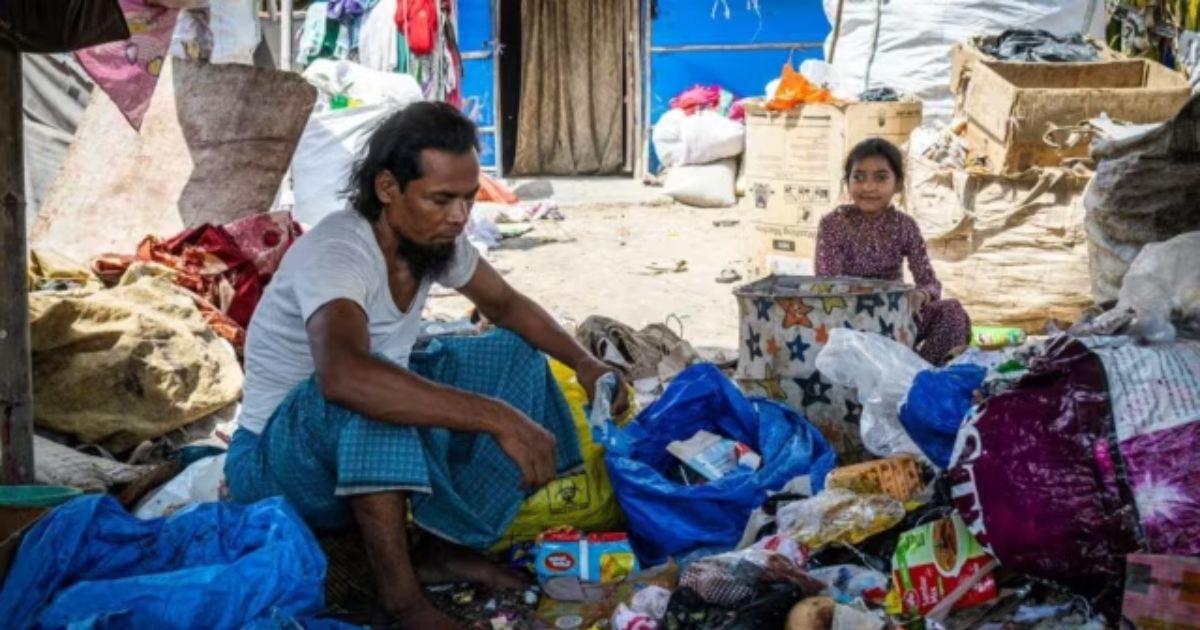
In 2017, Rohingya refugee Noor Mohammad and his wife arrived in India, only to be forced to relocate at least a dozen times in an effort to escape the dangerous conditions of refugee camps and avoid deportation.
Over the past seven years, their temporary homes were destroyed twice due to unexplained fires that ravaged Rohingya refugee camps in the northern Indian cities of Jammu and Nuh.
"Hindu leaders ordered us to vacate different areas a number of times in north India. They also threatened to retaliate with violent consequences if we disobeyed them,” Mohammad shared with VOA this week from an undisclosed city in southern India.
To evade arrest and potential deportation, Mohammad, 37, who fled to India following a military crackdown in Myanmar that drove over 700,000 Rohingya to Bangladesh, has been moving from one area to another. "The police arrested some Rohingya on charges of illegal entry into India. To evade arrest and possible deportation with my children and wife, I kept moving... Now, I have taken shelter in an urban slum and have gone underground,” he said.
For over five decades, minority Rohingya Muslims have sought refuge in neighboring countries like Bangladesh and India to escape persecution in Buddhist-majority Myanmar. However, in recent years, the Rohingya in India have faced police detentions for illegal entry and the threat of deportation.

Last week, the United Nations Committee on the Elimination of Racial Discrimination urged India to cease arbitrary detention and forcible deportation of Rohingya refugees back to Myanmar, where they risk severe human rights violations and abuses.
The U.N. committee expressed its concerns on July 2 about the arbitrary mass detention of Rohingya, including children, often in inadequate conditions and sometimes without due process or access to legal representation.
According to a 2019 UNHCR estimate, over 40,000 Rohingya refugees are in India, with about 22,000 registered with the U.N. agency. These refugees typically work in menial jobs and live in dilapidated shack colonies.
India, which has not signed the 1951 U.N. Refugee Convention, regards Muslim Rohingya refugees as "illegal immigrants," even though the Rohingya have lived peacefully in the country for decades. However, the refugees began facing increasing hostility after Prime Minister Narendra Modi’s Bharatiya Janata Party (BJP) came to power in 2014. In 2017, the BJP and other Hindu right-wing groups launched a campaign demanding the expulsion of all Rohingya living in a refugee camp in Jammu.
While no police records in India have linked the refugees to any terrorist or criminal activities, Hindu nationalist groups on social media have labeled the Rohingya as “terrorists” and “jihadists,” calling for their expulsion from India for years.
India’s Ministry of Home Affairs has repeatedly urged state governments to identify and deport all Rohingya “illegal immigrants” to Myanmar, where a growing civil war has led to new violence in their homeland in Rakhine State.
According to rights activists, around 800 Rohingya, including women and children, are currently held in Indian jails and detention centers after being charged with illegal entry. So far, only 18 Rohingya refugees have been sent back to Myanmar since 2021.
Some rights activists argue that these deportations violate Indian law.
Ujjaini Chatterji, a New Delhi-based lawyer, emphasized that while India is not a signatory to the 1951 U.N. Refugee Convention, the Indian constitution guarantees “the right to life and personal liberty, along with the right to equality before law” for all individuals, including noncitizens, within Indian territory.
"The Citizenship Act, 1955 and the Foreigner's Act, 1946, define an illegal migrant who can be deported by the executive in India; however, the Rohingya are not illegal migrants. They are, as per the Standard Operating Procedure (SoP) circulated by the Union of India dated 20 March, 2019, ‘foreigners claiming to be refugees,’ and they cannot be either detained or deported without their claims being assessed within the timeframes as per the SoP,” Chatterji told VOA.
“This is not being followed by the authorities, and detentions are happening without a fair assessment of the refugee claims.”
Meenakshi Ganguly, South Asia deputy director at Human Rights Watch, highlighted that the Rohingya are among the most persecuted communities in the world. “Instead of treating them with empathy, Indian authorities and ruling political leaders have incited hate against them,” she said.
“There is an ongoing conflict in Rakhine State. Most governments struggle when it comes to protecting refugees, but deporting them when their lives will be at risk not only violates international law but basic decency,” Ganguly told VOA.
She added, “The Indian government should instead be working with partners, including ASEAN [the Association of Southeast Asian Nations], Bangladesh, and others to ensure that Myanmar can have a rights-respecting government, and the Rohingya refugees can safely return.”
An official from the Indian Home Ministry in New Delhi, which handles refugee-related matters, declined to comment on Rohingya issues.
Bangladeshi author and rights activist Farhad Mazhar attributed the persecution of Rohingya refugees in India largely to their Muslim identity.
“BJP, the ruling party of India, supports the Hindutva forces that aim to turn India into a Hindu-only country. The party openly discriminates against Muslims,” Mazhar said, noting that a recently enacted measure offering citizenship to persecuted religious minorities from neighboring countries does not apply to Muslims.
“The world identifies the stateless Rohingya as the most persecuted minority in the world. Yet India is nonchalant about the plight of the Rohingya community from Myanmar simply because they are Muslim,” Mazhar stated.
BOB Post