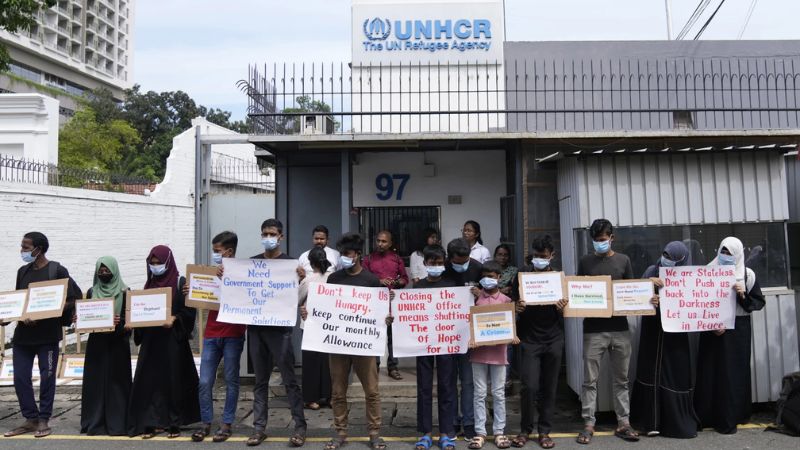
The Rohingya, one of the world’s most persecuted minorities, continue to face an uncertain future. Fleeing decades of systematic oppression in Myanmar, nearly 750,000 refugees escaped brutal violence in Rakhine state. In 2017 alone, joining hundreds of thousands already displaced in overcrowded camps in Bangladesh. A small group of 110 Rohingya refugees including children and a newborn, have sought temporary shelter in Sri Lanka. However, they now face immense hardships in their struggle to find stability and security.
Sri Lanka, though not a signatory to the 1951 Refugee Convention, has allowed asylum seekers to stay temporarily. However, these refugees are not permitted to work legally besides struggle to survive without sufficient support. A funding shortfall led the UNHCR to halt financial assistance in December 2022, leaving the refugees reliant on private donors and the goodwill of strangers. Many, like 37-year-old Anwar, hope for either safe repatriation to Myanmar or permanent resettlement in a third country where they can live with dignity.
Rohingya refugees in Sri Lanka recount years of systemic abuse in Myanmar. Anwar, a 37-year-old who has been in Sri Lanka since 2015, described the persecution faced by his community: “In 1982, they took away our citizenship. We couldn’t open bank accounts, send our children to school, or practice our religion. People were shot on their way to the mosque.” He fled Myanmar in 1992 and lived in a Bangladeshi refugee camp before escaping to Sri Lanka.
Abubaker, who fled Bangladesh after false accusations by local authorities, has since earned a software engineering degree in Sri Lanka but remains unable to work legally or open a bank account. “What dream can I have? The only option is labor work, even though I am qualified,” he lamented.
Hameeda, a single mother of three, struggles to survive without financial or educational support. She hopes to reunite with her husband, who is in Malaysia. “We are human beings and we all have families. God knows how we will go on,” she said.
Myanmar’s Role in the Crisis
The Myanmar government bears significant responsibility for the plight of the Rohingya. Decades of discrimination and repression culminated in the 1982 Citizenship Law, which rendered most Rohingya stateless and denied them basic rights. The estimated 600,000 Rohingya still in Myanmar live under severe restrictions, confined to camps and villages with no freedom of movement or access to food, healthcare, or education. Human Rights Watch has described their treatment as apartheid-like.
International observers and rights groups have consistently criticized Myanmar for its failure to ensure the safety and rights of the Rohingya. Until the Myanmar government recognizes the Rohingya as citizens and guarantees their protection, conditions for voluntary repatriation remain unattainable.
Call for a Permanent Solution
The global community must prioritize finding lasting solutions for the Rohingya crisis. While temporary hosting nations like Sri Lanka offer safety, their limited resources and legal frameworks are insufficient for long-term stability. Durable solutions require a multifaceted approach: addressing Myanmar’s systemic discrimination, facilitating voluntary repatriation with guarantees of safety and citizenship, and expanding resettlement opportunities in third countries.
Rohingya refugees like Anwar echo this sentiment: “The first option is to return to Myanmar with freedom and rights. The second is to find a country where we can live with dignity.” For now, their futures remain uncertain, and the world’s largest stateless population continues to wait for justice and stability.
Obaidur Chowdhury
BOB Post