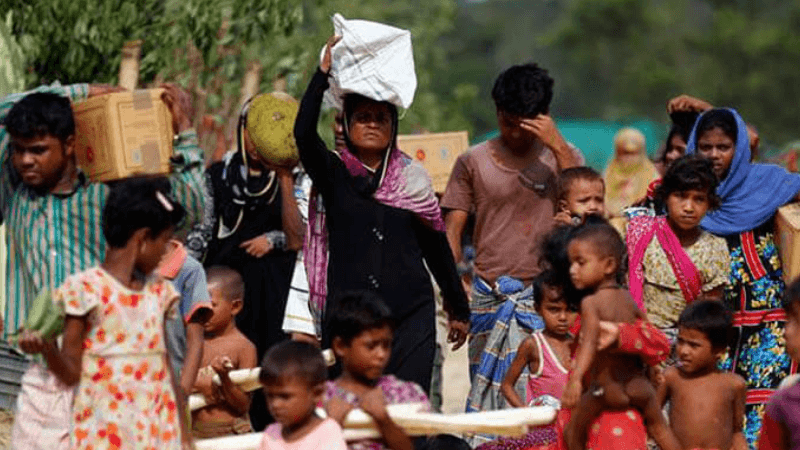
Violence and displacement among the Rohingya have resurged due to heightened attacks by armed groups in Myanmar. United Nations Secretary-General Antonio Guterres issued a warning this week, highlighting the continued suffering of the Rohingya amid escalating fighting and military bombings in the country. Armed groups resisting the military coup in 2021 started the wave of violence that grew more intense around the end of October of the previous year. The military's plans to impose forced conscription in February and extend the state of emergency in January has alarmed many, especially the Rohingya community. The Rohingya are arbitrarily targeted by bombs and coerced into joining the army, all while being denied citizenship and endured long-term persecution by the military and other authorities in Myanmar.
After fifty years of military control, Myanmar, formerly known as Burma, saw Aung San Suu Kyi win a landslide in the 2015 election. On February 1, 2021, however, the military executed a coup against her, which set off a series of large-scale demonstrations that turned into an armed insurrection as the military ruthlessly retaliated. Since the coup, 4,680 individuals have died as a result of the Myanmar military, according to the Assistance Association for Political Prisoners (AAPP).The Arakan Army, the Ta'ang National Liberation Army (TNLA), and the Myanmar National Democratic Alliance Army (MNDAA) launched a major offensive in October 2023 under the codename Operation 1027. As soldiers withdrew, leaving behind heavy weaponry and substantial ammunition, over 100 military posts were captured. In addition, the military is under increased pressure from anti-coup opposition organizations like the People's Defence Forces. In November 2023, the military admitted losing control of Chinshwehaw, a vital trade link to China's Yunnan province, following clashes with armed factions. Furthermore, in January, the Arakan Army asserted full control over Paletwa, a strategic town in Chin state, after seizing several military outposts. Responding with brutality, the military has imposed severe restrictions on the movement of the remaining Rohingya population, many of whom reside in restricted camps in Rakhine state.
“The Myanmar junta has been indiscriminately bombing Rohingya areas in different townships in Rakhine state,” said Nay San Lwin, co-founder of the Free Rohingya Coalition, a global network of Rohingya activists. He also said that during Monday's bombing of western Minbya township, 23 Rohingya, including children and a religious scholar, were killed, citing local sources. Thirty more Rohingya suffered injuries. “These attacks on Rohingya are happening everywhere.”
A failing economy and depleting natural gas reserves—which are essential for income—have weakened the legitimacy of Myanmar's military government. Many people are looking for methods to avoid service as a result of the recent installation of forced conscription, which has caused widespread concern across the nation. However, the restricted status and limited movement of the Rohingya people make it particularly difficult for them to evade recruitment.
The military administration of Myanmar declared on February 10 that the People's Military Service Law, which requires young men and women to be conscripted, will be enforced.

Since it was passed in 2010 by a previous military government, the law has been dormant. UN Special Rapporteur for human rights in Myanmar, Tom Andrews, criticized it, calling it evidence of the military's "weakness and desperation." The law allows for a two-year conscription into the armed forces, with the possibility of a five-year term during a national emergency for men and women between the ages of 18 and 27.
According to Nay San Lwin, there were at least 1,000 Rohingya individuals reported missing by the military from three towns: Buthidaung, Sittwe, and Kyaukphyu. These reports came from local sources. He continued by saying that some had already been sent to the battlefield after completing two weeks of training. "In Rathedaung Township, dozens of people have lost their lives while serving as human shields in combat," he continued. Porters have historically been deployed as human shields by the Myanmar military.
Rakhine state has faced intermittent communications blackouts since at least 2019, with a recent blackout reinstated in January of this year, providing only limited access to communication. Zaw Win, a human rights specialist at the independent rights group Fortify Rights, stated that during these restricted periods, Rohingya individuals have reached out reporting the military's abduction of friends and family members from internally displaced people (IDP) camps in Rakhine. Zaw Win continued, saying that one of the people his team had spoken with "witnessed how the junta military took away the Rohingya youth from Ward 5, Buthidaung." He claimed, "The Rohingya were apprehended by the soldiers in their car.
The military government has remained silent on the recruitment of Rohingya into the armed forces, although Nay San Lwin mentioned a denial published in state newspapers regarding allegations of forced recruitment. Activists emphasize the challenges faced by the 600,000 Rohingya residing in Rakhine, asserting that leaving Myanmar to avoid conscription is particularly challenging.
Moving between villages requires obtaining permission from village administrators, who, despite being Rohingya themselves, operate under military directives. This bureaucratic process is arduous and expensive, involving approvals from various local government entities. Activists argue that the recruitment of Rohingya into the military aims to stoke communal tensions between Rohingya and Rakhine Buddhists. Additionally, videos circulated on social media allegedly depicting Rohingya protests against the Arakan Army on March 19. However, some users speculate that these protests may have been orchestrated by the military.
"Junta is using the Rohingya as a proxy to protest against AA [Arakan Army] in Buthidang is not definitely organic," stated Aung Kyaw Moe, a cabinet member of Myanmar's National Unity Government, which is composed of elected MPs overthrown in the coup, in an X post.
Myanmar's military crackdown on the Rohingya in 2017 has been under investigation by the International Criminal Court (ICC) since 2019, but progress in the case has been lacking. Matthew Smith, executive director of Fortify Rights, criticized the international community for failing to refer Myanmar to the ICC, calling it both a practical and moral failure. The Gambia also filed a separate case at the International Court of Justice (ICJ) in 2019, accusing Myanmar of genocide against the Rohingya. Despite the ICJ's orders for Myanmar to take provisional measures to protect the Rohingya, no action has been taken. Smith emphasized the need for the UN Security Council to respond to Myanmar's defiance of these measures. Nay San Lwin suggested that resolving the Rohingya crisis requires a civilian government sympathetic to their cause, adding that significant international action against the military could alleviate their suffering.
BOB Post