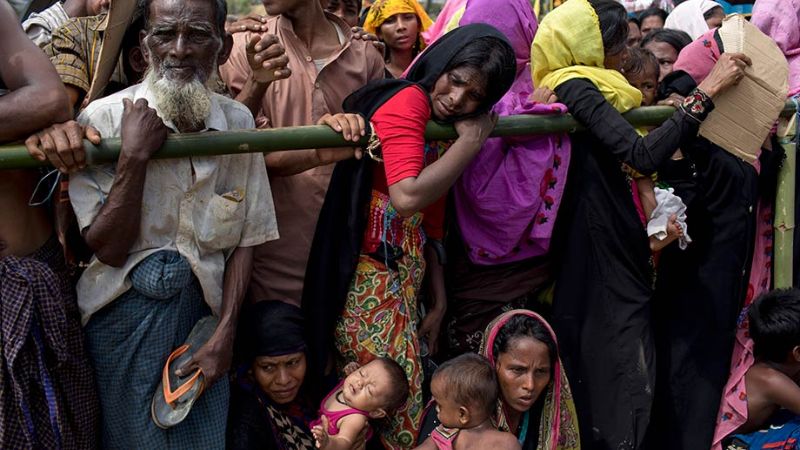
Repatriation efforts for the Rohingya, displaced since their mass expulsion from Myanmar's Rakhine state in 2017, have hit yet another obstacle following a recent attack by the Arakan Army (AA) in Maungdaw. This attack has further jeopardized the fragile repatriation process, raising alarms over the growing instability in the region.
The already complex situation in Myanmar has seen the emergence of powerful rebel alliances. The AA, previously a rival of groups such as the Ta'ang National Liberation Army (TNLA) and Myanmar National Democratic Alliance Army (MNDAA), has joined forces with these factions to form the Three Brotherhood Alliance. Meanwhile, another coalition, the Northern Alliance, comprising the Kachin Independence Army, TNLA, and MNDAA, has also gained momentum. Both groups are part of the Federal Political Negotiation and Consultative Committee (FPNCC), but the Rohingya remain excluded from all key political discussions.
Reports have surfaced alleging that both the Myanmar government and rebel factions have seized Rohingya property, further complicating the prospects for a peaceful repatriation. The discord within and between these rebel groups, combined with ethnic tensions, undermines any chance of institutionalizing democracy in Myanmar.
Meanwhile, on the geopolitical front, Myanmar’s external dealings have become clearer. China has emerged as a key player, securing a strategic foothold in the Bay of Bengal with the construction of the Kyaukpyu Port, which is the terminus of the China-Myanmar Economic Corridor. India has also completed the Sittwe Port in Rakhine, part of its broader strategy to connect its northeastern states to the rest of the country.
For Bangladesh, the challenges keep mounting. The country now hosts around 970,000 displaced Rohingya, with over 70,000 relocated to Bhashan Char. The prospects of voluntary repatriation remain slim as the Rohingya continue to reject any return without guarantees of safety and citizenship. Recent attacks in Maungdaw, a key repatriation zone, have only reinforced their fears.
While some Rohingya have been smuggled to Southeast Asia, the diaspora continues to grow, with significant populations in Saudi Arabia, Malaysia, and India. Bangladesh faces the difficult task of managing both the humanitarian crisis and the rising threat of diaspora-funded local resistance, which could morph into terrorism.
On the ground, frustrations are growing among local Bangladeshis. Once welcoming, they now resent the Rohingya, particularly due to the economic imbalances created by international relief efforts. The UN Refugee Agency (UNHCR) has expanded its aid to include local communities, but funding shortages remain a critical issue. In 2024, the UNHCR has received only a third of its requested $850,000 in aid for the region.
As international interest in the Rohingya crisis fades, and as Myanmar’s internal conflicts intensify, Bangladesh finds itself increasingly burdened. It must navigate complex relations with global powers like China, India, and Japan, all while managing its own growing responsibilities in the region.
BOB Post