The conflict in Myanmar’s Rakhine State has trapped ethnic minorities in a violent struggle, leaving communities displaced, fearful, and uncertain about their future. One such person is U Khup Thang, a Chin farmer whose life was torn apart earlier this year when artillery fire from clashes between the Arakan Army (AA) and Myanmar’s military destroyed his home and claimed his son’s life.
“I felt like I was living in a nightmare. I still can't find the words,” says Thang, speaking from an undisclosed location after fleeing the violence in Paletwa. His story mirrors the fate of many in the region who have been caught in the crossfire since the AA, a powerful ethnic armed group, launched a new offensive last November against military forces entrenched in Rakhine and Chin states.
The Arakan Army’s goal is the creation of an autonomous "Arakan Dream" — a vision of self-rule in a region Rakhine people consider their ancestral homeland. This recent wave of violence marks the AA’s second major push since 2018, and it has resulted in significant territorial gains, with the group controlling vast areas in central and northern Rakhine, as well as Paletwa in Chin State.
But the Myanmar military has responded harshly. Its bombings and shelling campaigns have not only devastated Rakhine but have also spilled over into minority communities, many of whom are not even directly involved in the conflict. In a cruel twist, the military has begun forcibly recruiting members of the persecuted Rohingya Muslim minority, using coercion and violence to enlist them into their ranks. Reports from Human Rights Watch suggest abductions, threats, and intimidation have been used against the Rohingya, who are already stateless and face severe restrictions on movement.
This deepening conflict has shattered lives across ethnic lines. More than 327,000 people have been forced to flee their homes, with civilians paying the highest price. The United Nations estimates that about three million people have been displaced across Myanmar since the coup in 2021.
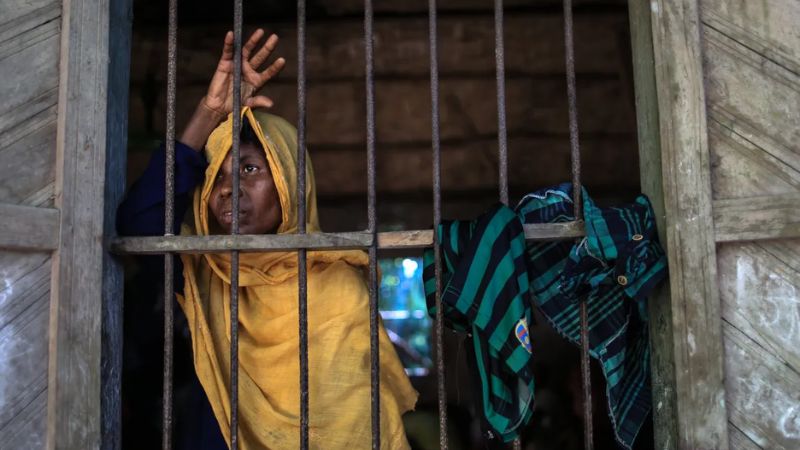
"We feel completely trapped. We can't escape, we can't move freely. It’s like being in a cage,” says Annawar, a Rohingya youth from Rakhine’s northern townships. His community, denied citizenship and subject to institutionalized restrictions for over a decade, is among the most vulnerable, unable to flee violence when it erupts.
For ethnic minorities like the Maramagyi, the Kaman, and the Mro, the situation is equally dire. Many have been driven from their homes, facing skyrocketing prices, a lack of food and medicine, and violence on all sides.
“We’ve had to leave everything behind. Only those too poor to flee are still there, struggling to survive,” says Naing Naing, a Maramagyi small business owner. He left Rakhine's capital, Sittwe, with his family in April, moving to Yangon in search of safety and a new life. Like many others, he now faces the challenge of starting from scratch in an unfamiliar place.
Even for those who stay behind, the daily reality of war is inescapable. Ruma, a Kaman humanitarian worker, describes a constant state of fear. “I can hear the clashes almost every night,” she says, adding that the cost of living has soared, with her commute to work now costing 70,000 kyats — an amount she can barely afford.
While the AA has promoted itself as a defender of all ethnic groups in Rakhine, claiming it fights for democracy and equality, some question their commitment to these principles. Particularly troubling is the AA’s stance towards the Rohingya, whom it continues to refer to as “Bengalis,” denying their claim to the land and dismissing them as foreign.
“The AA has always talked about unity, but when it comes to the Rohingya, they act very differently,” says a local rights activist who wished to remain anonymous. Allegations of violence against the Rohingya by AA forces, including the burning of villages, further fuel these concerns, though the group denies the accusations.
The AA, for its part, says it remains committed to inclusivity, and that its political wing, the United League of Arakan (ULA), is working towards a future where all ethnic groups can participate in governance. Yet, their vision of governance prioritizes central control, which some fear could become another form of authoritarianism.
“We’ve been oppressed for so long. We need a system that values the voices of all minorities, not just the Rakhine,” says Hsan, an ethnic Mro community worker. He worries that without true inclusivity, the smaller minority groups like his own will continue to be marginalized.
In the midst of all this, civilians are left to navigate a complex web of power dynamics, survival, and fear. “We can’t live separately,” says Hsan. “But the AA needs to show they truly care about the needs of everyone, not just the majority.”
BOB Post