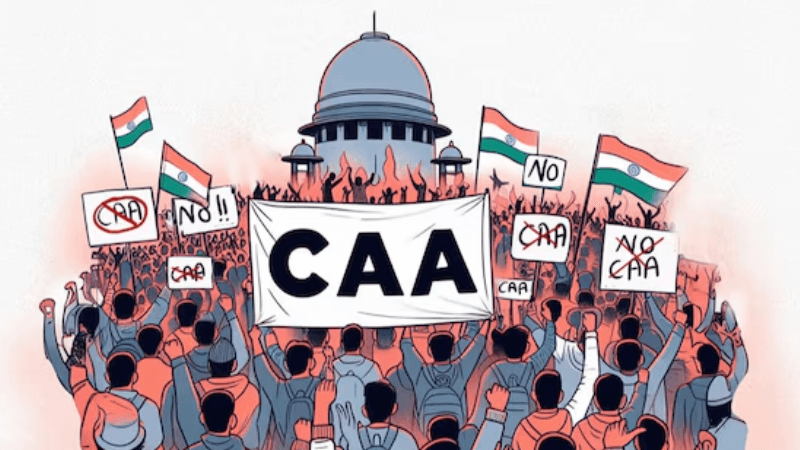
The Supreme Court declined to halt the enforcement of the Citizenship (Amendment) Act Rules recently notified by the government but issued notices to the Centre in response to petitions challenging both the Rules and the Citizenship (Amendment) Act of 2019. Chief Justice of India D Y Chandrachud led the three-judge bench that issued the notices, signaling a forthcoming legal examination of the contentious provisions and their implementation.
“Solicitor General Tushar Mehta submits that four weeks time may be granted to file response to the applications for stay at this stage. The request of four weeks time is opposed on the ground that in the meantime, if citizenship were to be granted, that process would become irreversible. Bearing in mind all the facts and circumstances, we direct that the proceedings be listed on April 9,” the bench, which included Justices J B Pardiwala and Manoj Misra, said.
The Supreme Court bench set a deadline for the Centre to file its response to petitions challenging the Citizenship (Amendment) Act and its associated Rules by April 2, with petitioners required to respond by April 8. Solicitor General Tushar Mehta, representing the Centre, informed the court of 236 petitions challenging the Act and 20 applications challenging the Rules. He requested additional time to prepare the government's reply. Mehta emphasized that the CAA does not revoke anyone's citizenship and only individuals who entered before 2014 are eligible for consideration.
Senior Advocate Indira Jaising, representing a petitioner, appealed to the court to issue directives preventing the grant of citizenship until a final decision is reached on the legal proceedings. She suggested that any citizenship granted under the Rules should be contingent upon the outcome of the ongoing petitions. Jaising emphasized that once citizenship is granted, it cannot be revoked under the law, but clarified that court orders could potentially override this principle.
Senior Advocate Kapil Sibal, representing the Indian Union Muslim League (IUML) as a petitioner, reiterated the request made by Senior Advocate Indira Jaising. Sibal highlighted that the notification of the Rules occurred more than four years after the enactment of the law, noting that under legal provisions, such notification should have been made within six months. He emphasized that the parliamentary process for notification had been followed since 2020, and initiating citizenship processes could render the pending petitions meaningless. Sibal argued that since the government had waited until now, it could continue to wait until the court had heard the matter, stressing that once citizenship is granted, it cannot be revoked. He emphasized the absence of urgency in initiating the citizenship process and underscored the existence of several pending challenges in the petitions, indicating significant constitutional law issues at stake.
The court refused to grant the plea for an injunction, citing the absence of necessary structures such as the national empowered committee and the district empowered committee. Despite pleas from Senior Advocate Indira Jaising, who emphasized the need for action, Senior Advocate Kapil Sibal suggested that they would return to court if circumstances changed. The court acknowledged their presence but did not make further commitments. Senior Advocate Ranjit Kumar, representing the Balochistan Hindu Panchayat, raised concerns about the impact of granting citizenship to persecuted Balochistani Hindus on the rights of others. Jaising argued that such individuals would gain the right to vote, while Sibal did not explicitly support the claim. Jaising continued to advocate for a statement from the Solicitor General ensuring no citizenship awards would be made under the new Rules in the interim, but Solicitor General Tushar Mehta declined to make such a statement.
In a court session, advocate Nizam Pasha, representing AIMIM president Asaduddin Owaisi, argued that the National Register of Citizens (NRC) was prejudiced against Muslims, while non-Muslims could benefit from the Citizenship Amendment Act (CAA). However, Solicitor General Tushar Mehta attempted to separate the NRC issue from the CAA, emphasizing that the court should focus solely on the grant of citizenship under the CAA. The court reserved its opinion, stating it would consider all arguments. Some petitioners suggested segregating issues related to Assam and Northeast states from others, which the court agreed to do. Meanwhile, the government issued rules to implement the CAA, aiming to facilitate citizenship for non-Muslim migrants from specific countries who arrived before December 31, 2014.
BOB Post