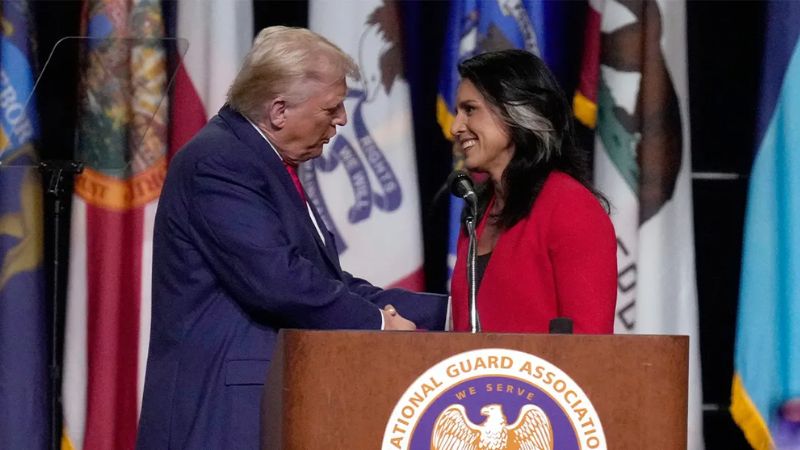
Tulsi Gabbard, a former Democratic congresswoman who recently joined the Republican Party to support Donald Trump, has been selected by the president-elect as the nominee for Director of National Intelligence. If confirmed, Gabbard would oversee the United States' 18 intelligence agencies, including the CIA, FBI, and NSA, with a combined budget exceeding $70 billion (£55 billion).
The nomination has drawn criticism due to Gabbard’s lack of direct intelligence experience and past allegations of amplifying Russian propaganda. She will require Senate confirmation to assume the role.
Reacting to the announcement on X, Democratic congresswoman Abigail Spanberger, a member of the House Intelligence Committee, expressed strong opposition. “Not only is she ill-prepared and unqualified, but she traffics in conspiracy theories and cozies up to dictators like Bashar-al Assad and Vladimir Putin,” she wrote.
Who is Tulsi Gabbard?
A military veteran who served in Iraq with a medical unit, Gabbard has broken political ground throughout her career. She was the youngest person elected to the Hawaii State Legislature at 21 in 2002 and later became the first Hindu member of the U.S. House of Representatives, serving Hawaii from 2013 to 2021.

Initially a Democrat advocating for progressive causes like government-run healthcare and free college tuition, Gabbard ran for the Democratic presidential nomination in 2020 before endorsing Joe Biden. However, in 2022, she left the Democratic Party, accusing it of being an “elitist cabal of warmongers.” Gabbard registered as an independent and became a Fox News contributor before joining the Republican Party less than a month ago.
Controversies on Syria and Ukraine
Gabbard’s nomination has reignited scrutiny over her past remarks on Syria and Ukraine. During her 2019 presidential bid, she was criticized for receiving favorable coverage from Russian state media and for her stance on Syrian President Bashar al-Assad. Gabbard defended a 2017 meeting with Assad, stating that Syria "does not pose a direct threat to the United States." She also expressed skepticism over Assad’s involvement in a chemical weapons attack, despite U.S. intelligence and the Trump administration attributing responsibility to the Syrian regime.
On Ukraine, Gabbard has made contentious statements about Russia’s invasion. On the day of the invasion, she suggested it could have been avoided if the U.S. and allies had acknowledged Russia’s "legitimate security concerns" about NATO expansion. She later asserted the existence of U.S.-funded biolabs in Ukraine, a claim dismissed by Republican senator Mitt Romney as "actual Russian propaganda."
International Reactions
Russian state media has framed Gabbard’s nomination as potentially complicating U.S.-Ukraine relations. Rossiya 1 correspondent Dmitry Melnikov commented that the move "does not bode well for Kyiv," highlighting Gabbard’s past criticism of President Zelensky and calls for dialogue with Russia.
If confirmed, Gabbard’s tenure would likely bring significant shifts to U.S. intelligence operations, with both domestic and international implications.
BOB Post