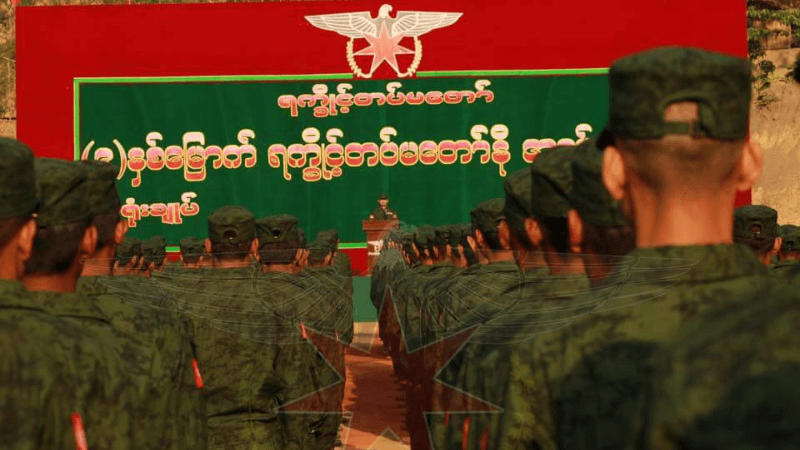
Since the 2021 coup, Myanmar's military junta has been losing control over significant portions of the country, notably in Rakhine State, where the United League of Arakan/Arakan Army (ULA/AA) has emerged as a dominant force. The ULA/AA, which bolstered its governance capabilities during a ceasefire from late 2020 to October 2023, has since dealt severe blows to the junta. Rakhine has suffered prolonged neglect and political repression, leading to economic hardship, conflict, displacement, and human rights abuses. As a result, the ULA/AA has assumed a central role in governance, though they acknowledge the need for further administrative improvement. This article discusses strategies for domestic and international organizations to engage with the ULA/AA in fostering development and achieving peace in Rakhine.
Established in 2009, the United League of Arakan/Arakan Army (ULA/AA) has rapidly ascended to become one of Myanmar's most formidable resistance groups. Despite its relatively brief existence, it has gained significant influence, especially in Rakhine State, where it governs various communities including Rakhine, Rohingya, and other minorities.
Recent battles with the Myanmar military have expanded its territorial control, encompassing urban as well as rural areas, including strategic locations like Paletwa Township. With control over eight full townships and partial control over five others, the ULA/AA has emerged as the primary governing entity in Rakhine. Given its increasing administrative responsibilities and the unlikelihood of the military reversing its territorial gains anytime soon, it is imperative for both domestic and international actors committed to aiding Rakhine's populace to engage with the ULA/AA.
Since late 2023, intensified fighting with the Myanmar military has led to a significant increase in the number of internally displaced persons in Rakhine State, surpassing 300,000.In order to efficiently provide humanitarian supplies under the blockades enforced by the military council, coordination between national and international groups is vital. This requires working closely with the ULA's Humanitarian and Development Coordination Office to ensure the distribution of aid reaches those in need.
The people of Rakhine have faced longstanding neglect in basic public services, a situation worsened by recent conflict. With the ULA assuming primary governance, there's a critical need for financial and technical assistance. This support is essential for infrastructure repair and maintenance, ensuring access to electricity and water, sustaining schools and hospitals while enhancing their quality, establishing effective justice systems, and bolstering other essential governance sectors. In media briefings, the ULA consistently emphasizes a non-confrontational approach towards economic investments in Rakhine, as long as they contribute to the region's development. They actively promote regional trade and business opportunities with neighboring countries and existing partners, encouraging the local population to prepare for such ventures.
This includes ongoing projects like the Kaladan Multi-Modal Transit Transport and the Kyaukphyu Special Economic Zone and National Gas project, as well as potential future endeavors. Supporting the ULA's development in energy management, environmental preservation policies, and economic strategies would be beneficial and timely for Rakhine's people.
The development of connections and mutual trust required for the full inclusion of Rakhine's many ethnic groups in the ULA's governance structure is still impacted by unresolved historical communal disputes in the region. However, in the face of deliberate efforts by the military junta to exacerbate intercommunal divides and mistrust – including forcibly conscripting Rohingya and forcing them to fight against the ULA – the ULA is actively trying to promote peaceful coexistence among diverse Rakhine communities. The ULA has appointed local administrators not only from the Rakhine community, but also from Muslim communities, and other minority groups in Rakhine. Further, the ULA has established communication offices for addressing complaints in case the action of any ULA official disrupts its efforts to promote peaceful coexistence.
In stark contrast to the military junta, the ULA is committed to regional stability and peace among diverse communities in Rakhine. The ULA is also very popular with much of the population in Rakhine, giving it significant political capital that can be used to try to change attitudes and behaviors in ways that reduce intercommunal mistrust and make peaceful co-existence more likely.
As the foremost military and governance entity in Rakhine, the ULA is dedicated to addressing humanitarian needs, delivering public services, fostering economic development, and promoting social cohesion and peace. While demonstrating responsibility in its approach, the ULA acknowledges the need for further improvement in administrative and technical capacities and welcomes external assistance. Urgently requiring more funding to meet the region's humanitarian and public service demands, the ULA has established a Humanitarian and Development Coordination Office to facilitate collaboration with domestic and foreign organizations. Entities interested in aiding Rakhine's populace and advancing regional stability are encouraged to engage with this office.
BOB Post