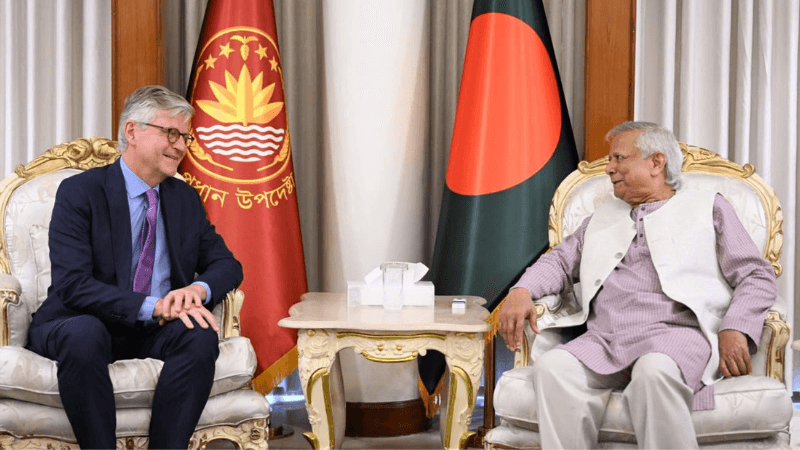
Chief Adviser Prof Muhammad Yunus on Sunday called on the United Nations to recruit more women peacekeepers from Bangladesh, reinforcing the country's steadfast commitment to international peacekeeping and global security.
During a meeting with UN Under-Secretary-General for Peace Operations Jean-Pierre Lacroix at the state guest house Jamuna in Dhaka, Yunus emphasized Bangladesh’s dedication to gender inclusivity in peace operations.
“One thing that I encourage is the participation of more Bangladeshi women in peacekeeping missions,” Yunus stated, as both sides engaged in comprehensive discussions on strengthening peacekeeping collaboration.
Bangladesh currently ranks among the top three troop- and police-contributing countries (TPCCs) with 5,677 peacekeepers deployed across 10 of the 11 active UN missions worldwide.
Jean-Pierre Lacroix welcomed Yunus’s appeal, highlighting the UN’s growing emphasis on gender-balanced peacekeeping forces. “We don’t want to confine women to specific roles,” Lacroix said. “The UN is committed to supporting the deployment of women across all aspects of peacekeeping—from field operations to leadership positions.”
Increased participation of women in peacekeeping is widely recognized as a catalyst for more effective missions. Women peacekeepers often play a crucial role in engaging with local communities, especially with women and children in conflict zones. Their presence can help build trust, defuse tensions, and enhance access to vital services. Moreover, gender-diverse peacekeeping units are often better equipped to respond to cases of sexual violence and ensure protection measures are sensitive and inclusive.
Studies by the UN have shown that missions with more women tend to have better performance, stronger community relations, and fewer misconduct allegations. With Bangladesh pushing for more female representation, it aligns both with UN goals and the broader objective of inclusive and responsive peacekeeping.
Chief Adviser Yunus reiterated Bangladesh’s readiness to deploy additional troops and police as needed, noting the country’s pledge of five units at the Rapid Deployment Level under the Peacekeeping Capability Readiness System (PCRS). He also called for enhanced Bangladeshi representation in leadership roles both at UN headquarters and in the field.
In response, Lacroix assured continued UN support in strengthening Bangladesh’s presence and leadership in global peace operations.
Yunus reaffirmed that all Bangladeshi peacekeepers undergo strict UN vetting procedures and welcomed deeper collaboration on training, accountability, and human rights compliance.
The meeting also touched on regional security concerns, particularly the escalating conflict in Myanmar and its spillover effects. Yunus expressed alarm over cross-border shelling, civilian casualties, and economic disruptions near the Naf River, which separates Bangladesh from Myanmar.
He warned that the worsening situation could threaten regional stability and urged the international community to act swiftly to prevent a deeper crisis.
Underscoring the urgency of resolving the Rohingya crisis, Yunus urged a unified global approach. He referenced the recent visit of UN Secretary-General António Guterres to the Rohingya refugee camps in Cox’s Bazar, which, according to Yunus, reignited hope among displaced Rohingyas for a safe and dignified return to their homeland.
A Bangladeshi delegation, led by the foreign adviser, is set to attend the upcoming UN Peacekeeping Ministerial Conference in Berlin from May 13–14, where these issues are expected to be discussed further.