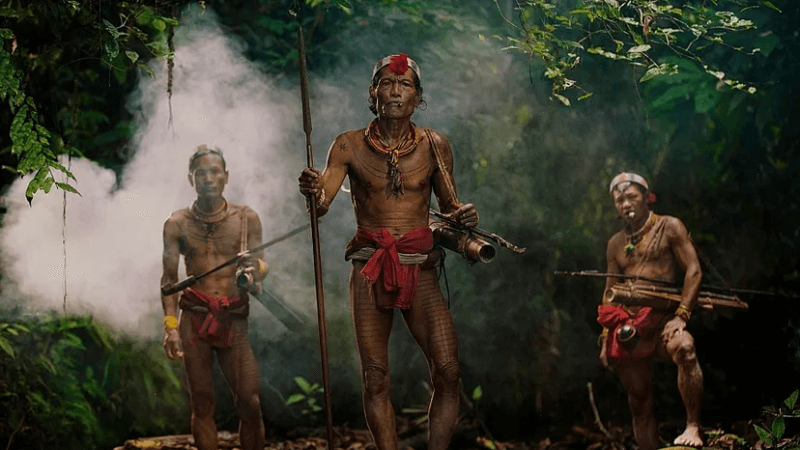
In the lush rainforests of the remote island of Siberut in Indonesia, the Mentawai tribe, numbering around 60,000, clings fiercely to its ancient ways, untouched by the currents of Hinduism, Buddhism, or Islam that have shaped much of Indonesian culture. These indigenous people, with traditions reminiscent of the original Austronesian settlers from Taiwan 4,000 years ago, now face the encroachment of the modern world, challenging their unique way of life.
The Indonesian government has applied pressure on the Mentawai tribe to abandon their customs, embrace a government-approved religion, and relocate to government villages. This clash between tradition and modernity, compounded by the allure of contemporary life for the younger generation, has resulted in a significant generational disjunction within the Mentawai community. Despite governmental efforts, there are individuals like Teu Kapik Sibajak, covered in tattoos and wearing only a loincloth, who resist the pressure to forsake their traditional lifestyle. Teu Kapik Sibajak and his wife, Teu Kapik Sikalabai, are among the last guardians of Mentawai's traditional practices, residing deep in the rainforest.
The physically demanding lives of the Mentawai people pose a challenge for the younger generation. Petrus Sekaliou, the son of Teu Kapik Sibajak and Teu Kapik Sikalabai, reflects on the difficulties faced by the elderly who continue to toil, emphasizing the need for them to work until they can no longer. Unlike his parents, Petrus wears Western clothing and communicates fluently in bahasa Indonesian, the national language, residing in a village on the outskirts of the forest.
Petrus, torn between the modern world and his parents' traditional lifestyle, plans to return to the forest when his parents can no longer care for themselves. The alternative, moving them to the village with its motorbike whirs and cellphone banter, is deemed too wrenching for their old age. "They're happy in the forest," he asserts. "This is what they know."
The clash between the Mentawai tribe and the modern world traces back to the 1950s when the Indonesian government sought to homogenize the nation. Citizens were mandated to adopt one of the state-recognized religions. The Mentawai, adhering to their animist beliefs, resisted the forced conversion, but many eventually chose Christianity due to its compatibility with their cultural practices involving pigs, central to their way of life. The push for conversion intensified during the Suharto dictatorship, fueled by concerns about Communist influence. The Mentawai, who had not embraced a state-approved religion, were targeted.
Only in the 1990s, with the arrival of Western tourists, did the local government recognize the commercial advantages of allowing traditional Mentawai to live freely. Yet, by then, an entire generation had been raised without the touchstones of their ancestral traditions. Today, around 2,000 Mentawai practice their traditional beliefs, a fraction of the population. Efforts to revive Mentawai tradition have started, with activists successfully incorporating Mentawai culture into local elementary school curriculums. However, the scars of decades of government oppression run deep, and many Mentawai lament the loss of their cultural heritage.
As the youngest generation comes of age in a less restrictive era, there is hope for a resurgence of Mentawai culture. Despite the challenges, Mentawai elders can now freely worship and dress according to their traditions. Still, the struggles persist, and many Mentawai, like Petrus Sekaliou, express a yearning for the simplicity and happiness found in the forest, away from the stresses of modern life. In the twilight of their years, the older generation remains a living testament to the resilience of the Mentawai tribe, holding onto a way of life that is under constant threat from the relentless march of modernity.
BOB Post