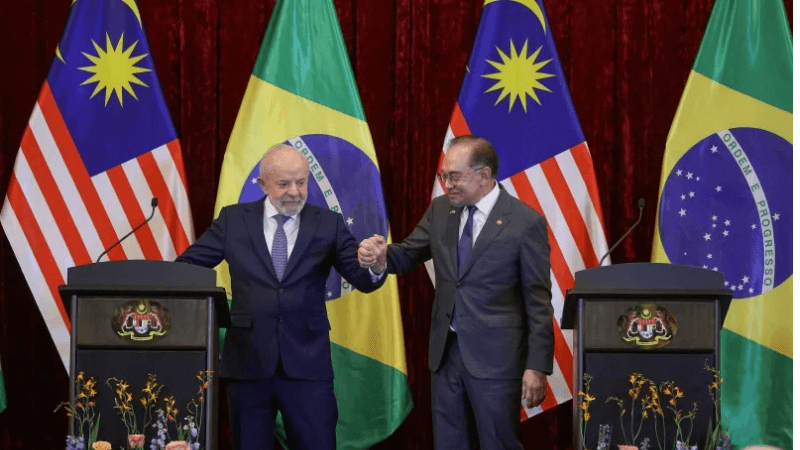
Brazil and Malaysia have agreed to establish a joint venture for semiconductor production, a move signaling a strategic push into the high-stakes global microchip market. The announcement was made by Brazil’s Minister of Science, Technology, and Innovation, Luciana Santos, in an exclusive interview with Brasil de Fato, a media partner of the BRICS television network.
The new enterprise will specialize in producing microchips specifically for electric vehicles (EVs) and equipment vital for the clean energy transition. Minister Santos noted that the initiative is designed to strengthen Brazil's national industry and secure a more prominent role for the nation in the global semiconductor supply chain, which has been a source of significant geopolitical tension.
The agreement was finalized during a state visit by Brazilian President Luiz Inacio Lula da Silva to Malaysia. The visit also saw the signing of five other documents on cooperation in science and technology, covering key areas such as the bioeconomy, space, and digital transformation, three of which are directly overseen by Brazil's Ministry of Science.
This international partnership complements Brazil's aggressive domestic strategy. The Brazilian government has recently revived operations at the country’s only chip manufacturing facility.

Furthermore, the ministry is developing the extraction and processing of its vast rare earth metal reserves a critical component for all high-tech manufacturing. Brazil holds the world’s second-largest reserves of these materials after China. A special council under the President has been established to coordinate this strategic work.
BRICS Nations Reshape Global Chip Supply
The Brazil-Malaysia pact is indicative of a broader, concerted effort by BRICS nations to build a parallel ecosystem for high-tech manufacturing, reducing their dependence on traditional, Western-led supply chains.
As the United States, Japan, and Europe consolidate their own chip alliances, BRICS members are accelerating their investments to secure "technological sovereignty."
- China is investing hundreds of billions through its "Big Fund" and "Made in China 2025" policies, aiming for 70% self-sufficiency in semiconductors.
- India has launched a $10 billion incentive program, the "Semiconductor Mission," attracting global giants to establish fabrication plants in the country.
- Russia is also reportedly pouring tens of billions into developing its domestic microelectronics industry.
Analysts view these moves as a clear geopolitical strategy. By fostering "South-South" cooperation like the new Brazil-Malaysia venture and controlling vast reserves of raw materials (like Brazil's rare earth metals), the BRICS bloc is collectively positioning itself as a formidable, self-reliant force. This new alliance aims to insulate its members from supply chain shocks and establish a significant foothold in the next generation of technology, particularly in the booming EV and green energy sectors.
BOB Post