Myanmar’s military government has asked Russia to help monitor its upcoming elections in December and January, just days after announcing plans to invite international observers, The Irrawaddy reported.
On Wednesday, Russian Ambassador Iskander Azizov met with the chairman of Myanmar’s Union Election Commission (UEC), Than Soe, in Naypyitaw. According to junta media, they discussed issues such as advance voting, political parties, candidate registration, electoral procedures, and electoral systems.
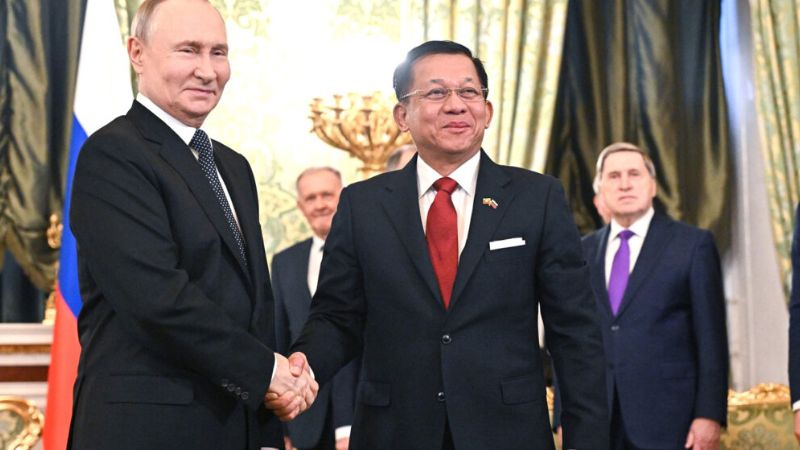
Russia remains one of the junta’s few close allies, along with China and India, and is also a key supplier of weapons. Junta leader Min Aung Hlaing is currently in Moscow at the invitation of President Vladimir Putin to attend the World Atomic Week forum. He had promised to invite Russian election observers as early as last year, before even setting the election date.
With less than three months before polls open on December 28, coordination between Myanmar and Russia has increased. Earlier this week, Myanmar’s Finance Minister Kan Zaw hosted Russian State Duma vice chairman Sholban Kara-Ool in Naypyitaw to discuss Moscow’s role in supporting the election.
Since the 2021 coup, Russia has openly supported the junta’s political plans. Both countries’ election commissions have signed cooperation agreements, and delegations have observed each other’s polls. In 2024, former UEC chairman Ko Ko attended Russia’s presidential election, where Vladimir Putin claimed a landslide victory in a vote criticized by Western governments and independent observers as neither free nor fair.
Russia also has close ties with Myanmar’s military-backed Union Solidarity and Development Party (USDP). Russian officials often visit the USDP headquarters in Naypyitaw, while USDP leaders have joined Russian election forums and signed agreements with Putin’s ruling United Russia party.
The junta is expected to invite Russia, China, India, Belarus, Cambodia, Thailand, and Laos as election observers. Meanwhile, Western governments, several ASEAN countries, Myanmar’s opposition National Unity Government (NUG), ethnic armed groups, and civil society have rejected the planned election as illegitimate.
BOB Post