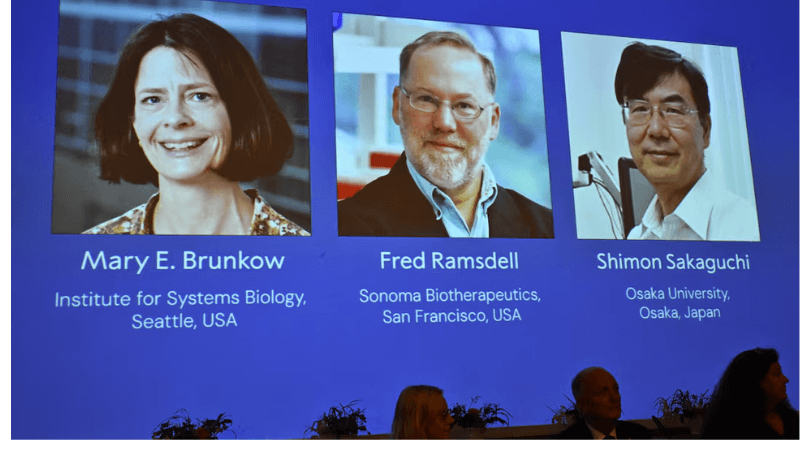
Scientists Mary E. Brunkow, Fred Ramsdell, and Shimon Sakaguchi were jointly awarded the 2025 Nobel Prize in Physiology or Medicine on Monday(October 6) for their revolutionary discoveries concerning "peripheral immune tolerance," a vital biological mechanism that stops the immune system from attacking the body's own tissues.
The announcement, made by the Nobel Assembly at the Karolinska Institute in Stockholm, marks the first prize of the Nobel season. The committee praised the laureates' work, stating, "Their discoveries have laid the foundation for a new field of research and spurred the development of new treatments."

The trio’s research solved a fundamental puzzle of immunology: how the body’s powerful defense system distinguishes between harmful invaders and its own healthy cells. Their collective work has provided a detailed understanding of the active, regulatory processes that maintain this crucial balance.
Dr. Shimon Sakaguchi was recognized for his pioneering identification of a specific class of immune cells, now known as regulatory T cells (Tregs). He demonstrated that these cells function as the immune system's dedicated "peacekeepers," actively suppressing other immune cells that might otherwise cause damage to the body. This discovery overturned previous notions by showing that tolerance is an active process, not simply a passive one.
Building on this, the research by Drs. Mary E. Brunkow and Fred Ramsdell provided the genetic key to this process. They identified the gene FOXP3 as the "master switch" that is essential for the development and function of these regulatory T cells. Their findings established a direct link between a single gene and the critical task of immune self-control, explaining why mutations in FOXP3 lead to devastating autoimmune diseases.
The impact of these discoveries on modern medicine has been profound and far-reaching. By understanding the Treg and FOXP3 pathway, scientists can now develop therapies to manipulate the immune response with incredible precision. In the field of oncology, new treatments aim to block Tregs within tumors, which cancers often exploit to hide from the body's defenses. This approach effectively "releases the brakes" on the immune system, allowing it to attack cancer cells.
Conversely, for autoimmune diseases such as lupus and rheumatoid arthritis, researchers are working to enhance the function of these same Tregs to restore balance and calm the misguided immune assault. This same principle is being applied to organ transplantation, where boosting Treg activity offers the potential to prevent organ rejection and reduce the need for harsh immunosuppressive drugs. The foundational work of the three new laureates has transformed immunology from a science of observation into one of purposeful intervention, offering new hope to millions of patients worldwide.
BOB Post